Most CPQ evaluations prioritize sales velocity, discount governance, and quote accuracy because these metrics matter to revenue operations and sales leadership. Finance teams evaluating the best CPQ for complex revenue face a fundamentally different question: how does the output of this system affect our ability to recognize revenue correctly under ASC 606?
CPQ stops being just a sales tool the moment your revenue model involves bundles, usage-based pricing, variable consideration, or subscription modifications. In these scenarios, CPQ becomes the originating system for data that finance must later decompose, allocate, and schedule.
When CPQ platforms are not designed with revenue recognition logic in mind, they create structural gaps that force finance teams into manual reconciliation, spreadsheet-based allocation models, or reliance on billing systems that were never intended to serve as accounting sub-ledgers. The problem is that CPQ outputs don’t map cleanly to the accounting constructs that ASC 606 requires.
How CPQ Data Creates Downstream Accounting Risk
CPQ platforms were designed to accelerate sales workflows, enforce pricing rules, and route approvals, not to support downstream accounting treatment of bundled or tiered pricing. The data structures CPQ uses (product hierarchies, price books, discount waterfalls) are sales-oriented and do not inherently align with ASC 606’s concept of distinct performance obligations. A CPQ may allow a sales representative to bundle a software license, implementation services, and annual support into a single line item with a blended discount. That’s fine for closing deals, but it creates an immediate problem for revenue recognition: finance must unbundle that line item, determine standalone selling prices for each component, and allocate the transaction price, none of which the CPQ was designed to facilitate. Revenue recognition decisions happen at contract execution, delivery, and over the life of the contract, not at the point of quote creation.
The Quote-to-Revenue Handoff Where Compliance Falls Apart
The breaking point occurs at the handoff between CPQ and billing, and again between billing and the general ledger. CPQ generates a quote with hierarchical line items, bundled pricing, and discount logic. The billing system consumes this data but operates on a different schema, one optimized for invoice generation and payment processing, not accounting treatment.
When the billing system flattens CPQ line items into invoice line items, it collapses the hierarchical structure that accounting needs to perform standalone selling price allocation. A CPQ may output a parent line item with three child components, each representing a distinct performance obligation. The billing system invoices the total amount, losing the parent-child relationship. Accounting must now reconstruct the bundle manually to determine how the transaction price should be allocated across performance obligations, a process the billing system was never designed to support.
The second break occurs when billing data flows into the ERP. Billing systems pass invoice totals and payment status, but they do not pass the accounting metadata required for revenue recognition: performance obligation identifiers, delivery milestones, or contract modification flags. The ERP receives an invoice amount and a customer ID, but it does not know whether that amount should be recognized immediately, deferred, or allocated across multiple periods.
Accounting teams compensate by building custom integration logic, middleware that enriches billing data with accounting context before it reaches the ERP. This middleware becomes a single point of failure. When the CPQ or billing system changes its data model, the integration breaks, and accounting discovers the issue only when revenue schedules no longer reconcile to the general ledger.
The Fundamental Divide Between CPQ and Revenue Recognition
CPQ operates in a pre-contract state, while revenue recognition is a post-contract, post-delivery accounting function. CPQ cannot predict how a quote will ultimately be delivered, modified, or invoiced. It cannot determine whether a performance obligation will be satisfied at a point in time or over time, because that determination depends on contract terms, delivery events, and customer acceptance, none of which have occurred at the point of quote creation.
Even CPQ platforms with basic revenue scheduling capabilities do not replace the need for a dedicated revenue recognition system, because they cannot handle the full complexity of ASC 606 logic: constraint analysis for variable consideration, contract modification accounting, or multi-element allocation across amended contracts. The data CPQ generates is optimized for deal approval, not for the multi-period accounting treatment that follows contract execution.
What CPQ Gaps Cost Finance at Close
When CPQ outputs don’t align with revenue recognition requirements, the close cycle stretches by days. Formula errors, version control issues, and reconciliation gaps pile up, and auditors flag them as control weaknesses.
The audit trail breaks at the point where CPQ data is manually transformed. Auditors require documentation showing how a bundled quote with a blended discount was decomposed into distinct performance obligations, how standalone selling prices were determined, and how the transaction price was allocated. When this logic exists in spreadsheets rather than in a system with enforced business rules, the company must produce evidence of manual review and approval for every allocation decision. The risk compounds as deal volume increases. A finance team that can manually process fifty complex deals per quarter cannot scale to five hundred without either adding headcount or accepting higher error rates.
Contract modifications create a second layer of complexity. When a customer upgrades mid-term, finance must determine whether the modification requires cumulative catch-up adjustment or prospective treatment. CPQ systems generate amendment quotes but do not preserve the relationship between the original contract and the modification in a way that supports this analysis. Finance must manually track contract lineage, compare original and amended terms, and apply the appropriate accounting treatment. This process is slow and frequently breaks, particularly when modifications occur across multiple periods or involve changes to both pricing and deliverables.
Why “Best CPQ Software” Depends on Revenue Recognition Complexity
The best CPQ software depends on your revenue recognition complexity. For companies with straightforward revenue models like single deliverables recognized at a point in time, no bundling, no variable consideration, CPQ limitations rarely create downstream problems. The billing system can handle revenue recognition, and the ERP can post journal entries without requiring extensive data transformation. In these scenarios, CPQ evaluation should focus on sales efficiency, discount governance, and quote accuracy. Revenue recognition is a secondary consideration because the accounting treatment is simple enough that most billing platforms can support it without manual intervention.
That changes when your revenue model involves multi-element arrangements, usage-based pricing, or contract modifications. In these environments, CPQ becomes the originating system for data that finance must later decompose, allocate, and schedule across multiple periods.
The “best” CPQ is one that outputs data in a structure that minimizes downstream transformation. Finance teams should evaluate whether the CPQ can pass structured line item hierarchies to the revenue recognition system, whether it supports custom fields for performance obligation tagging, and whether it preserves discount allocation at the line item level. Integration architecture matters more than feature depth. A CPQ with clean API documentation and well-defined data export formats may be preferable to one with advanced pricing rules but poor integration support.
The evaluation must also account for the role of dedicated revenue recognition software. If the company is using or planning to implement a revenue recognition platform, the CPQ evaluation should focus on compatibility: Can the CPQ export data in a format the revenue system can consume without custom scripting? Does it support the metadata fields the revenue system requires? If the company is relying on the ERP or billing system for revenue recognition, the CPQ evaluation must account for the limitations of those systems, neither can handle complex allocation logic or contract modification accounting. The goal is a CPQ that doesn’t make accurate, auditable revenue accounting harder than it needs to be.
Where RightRev Fits in the CPQ Architecture
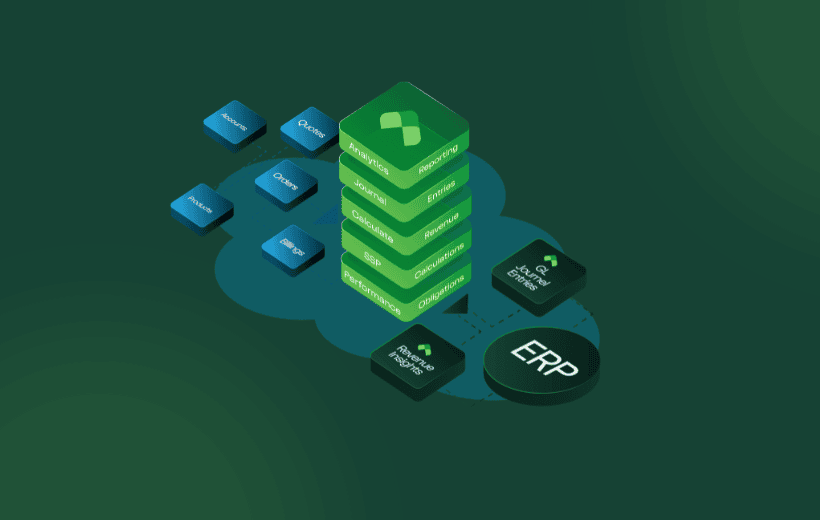
It does not replace CPQ, billing, or the ERP, it sits between them as a specialized sub-ledger that translates transactional data into accounting data.
CPQ generates quotes -> Billing systems generate invoices and track usage -> The ERP records journal entries and maintains the general ledger -> Revenue recognition software consumes outputs from CPQ and billing, applies ASC 606 logic, and produces the journal entries that the ERP posts.
CPQ, billing, and the ERP were all built for something else. None of them were designed to handle allocation, scheduling, or modification accounting.
The reason revenue recognition software exists as a separate layer is simple: upstream systems can’t do what it does.
- Billing platforms track what was invoiced and when payment occurred. They do not track performance obligations, standalone selling prices, or the cumulative catch-up adjustments required when contract terms change.
- ERP systems provide the chart of accounts and financial reporting structure, but they do not contain the business rules needed to decompose a bundled transaction or determine whether a contract modification requires retrospective treatment.
- Revenue recognition software maintains the linkage between the original contract, subsequent amendments, and the revenue schedules that span multiple periods. It provides the audit trail that connects a quote line item to the revenue recognized in the general ledger, preserving the allocation methodology and SSP determinations that auditors require.
If you are evaluating your current stack, start by mapping how data moves from quote creation to revenue posting. Identify where manual intervention occurs, whether it’s spreadsheet allocation, SSP lookups, or modification analysis, and assess whether those processes can scale as deal volume and contract complexity increase.
Salesforce CPQ handles the quote side well. It enforces pricing rules, manages approvals, and outputs structured line item data that downstream systems can actually work with. But it doesn’t do revenue recognition, and it was never meant to.
RightRev sits between Salesforce CPQ and your ERP as a dedicated revenue sub-ledger. It consumes quote and billing data, applies ASC 606 logic, handles contract modifications, and produces the journal entries your ERP posts. The audit trail runs end to end, from quote line item to recognized revenue, no spreadsheets filling the gaps.
For companies with complex revenue models, that combination closes the structural gap this article has been describing.