Lessor Accounting & RevRec Automation for XaaS

Monetize any hardware + software bundle with compliant and unified ASC 842/606 and IFRS 16/15 automation.

lease accounting
RightRev

Unified Compliance for Lease Accounting and Revenue Recognition

One single source of truth for Lessor Accounting and RevRec that’s audit-ready, automated, and built for high-volume XaaS and equipment-software bundles.

  • usage billing icon

    Reduce Audit Risk & Costs

    One authoritative system eliminates misstatements and manual reconciliation. Event-driven automation lowers audit risk and audit fees.

  • volume icon

    Enable XaaS Innovation

    Launch hardware + software + services with usage, variables, credits, upgrades, or refresh rights. Unified contract data keeps GTM fast and accounting clean.

  • journal entry icon

    Automated Lessor Accounting & RevRec

    Automate all lessor contract data. No parallel tracking, no spreadsheets. Schedules and journal entries generate instantly across ASC 842/IFRS 16 and ASC 606/IFRS 15 for a faster close.

Automated Lessor Accounting Engine

Lessor Accounting

01/

Unified Lease Revenue Dashboard

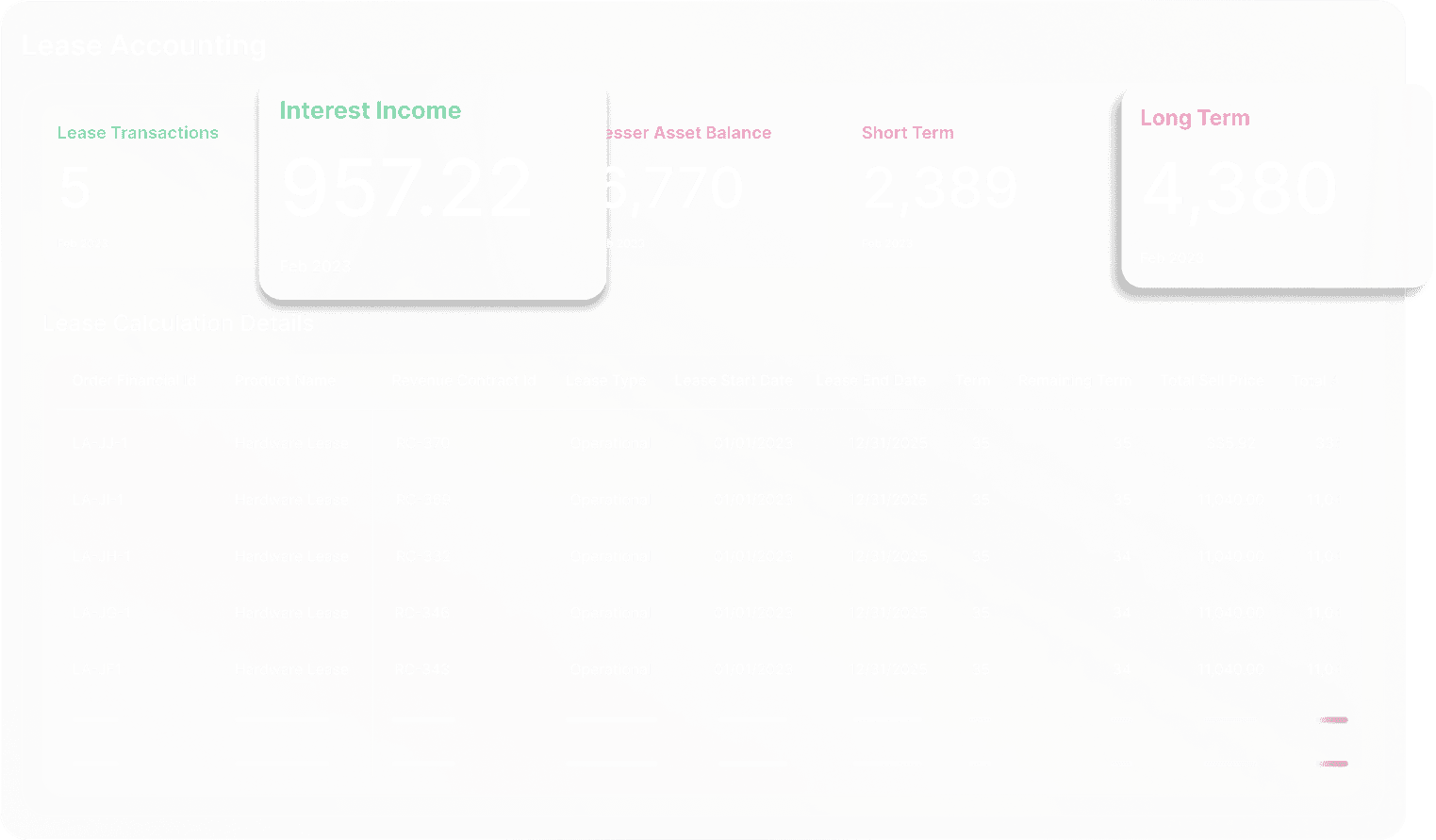
Lease accounting tools were built for lessees, not lessors. They track liabilities and expenses but can’t run ASC 842/IFRS 16 and ASC 606/IFRS 15 revenue together. RightRev does both, automatically calculating PV, IRR, interest, indexation, and modifications across every contract and remeasurement, all visible in one clear dashboard.

Forecast

02/

Reliable Billing Forecasts

Trusted forecasts for all payment types: fixed, variable, usage, escalators and index-linked, tied directly to your lease and revenue schedules.

Amortization

03/

Automated Lease Amortization

Compliant amortization and interest schedules that update instantly across ASC 842/IFRS 16 and revenue reporting.

Journal Entries

04/

Audit-Ready Lessor Journal Entries

Accurate entries for measurements, interest, variables, and remeasurements—ready for review and ERP posting.

lease accounting journal entry

Manual Work Shouldn’t Cost You Compliance

Modifications trigger rework. Spreadsheets turn one change into dozens of recalculations—and one mistake can break your schedules and GL. Automate ASC 606/842 and IFRS 15/16 in one system and close in days, not weeks.

FAQ’s

The shift to bundled contracts created an immediate, complex financial reporting challenge. When a company offers a customer the right to use an identified asset (the hardware) for a period of time, that company becomes a lessor. This is where ASC 842 applies.

While the new lease standard, ASC 842, is widely known for forcing lessees (customers) to record Right-of-Use (ROU) Assets and Lease Liabilities on their balance sheets, the standard equally governs the income side for vendors (lessors).

For a lessor, the accounting involves calculating lease receivables, unearned interest income, and the value of the residual asset (the estimated value of the hardware at the end of the term).

The most critical lessor accounting decision is lease classification, which determines when the revenue or income is recognized:

  • Sales-Type Lease: Selling profit is recognized upfront, at lease commencement (Day 1), assuming the lease transfers control of the underlying asset to the lessee, consistent with a sale under ASC 606.
  • Operating Lease: Lease income is recognized over the lease term, usually on a straight-line basis.
  • Direct-Financing Lease: Interest income is recognized over the lease term using the effective interest method.

The rise of XaaS models means hardware is rarely sold alone; it is bundled with services, software, and consumables. This is especially true for Hardware-as-a-Service (HaaS), Equipment-as-a-Service (EaaS) and Device-as-a-Service (DaaS), and other recurring models where the lessor provides equipment over time, often bundled with software and services. These arrangements often contain embedded leases and multiple components that have to be untangled for accounting purposes.

From the lessor side, a single customer contract can give rise to two separate economic streams:

  • Lease income on the equipment

Under ASC 842, lessors classify leases as operating, sales-type, or direct financing (see above). That classification drives whether profit is recognized up front or spread over time, and whether you carry a receivable or the underlying asset on your balance sheet.

  • Revenue from non lease components 

Under ASC 606, you recognize revenue for things like: 

  • Cloud or on-prem software subscriptions
  • Maintenance and support
  • Professional services
  • Usage or outcome-based charges

This blending forces a collision between ASC 842 and the revenue recognition standard, ASC 606. The Financial Accounting Standards Board (FASB) created a regulatory mandate linking these two standards, specifically for lessors offering bundles. For lessors, these standards are designed to work together, not in separate silos.

  1. Mandatory Separation: ASC 842 requires the lessor to separate the contract into lease components (the hardware) and non-lease components (the services or software).
  2. Mandatory Allocation: The total contract price must then be allocated to each component using the Standalone Selling Price (SSP) principles of ASC 606. This crucial allocation step must occur before either ASC 842 or ASC 606 recognizes income.

This requirement means that for every EaaS contract, two distinct and complex accounting standards must run in lockstep, often requiring significant complexity and judgment.
842 + 606 Are Still High-Risk Areas

As explained above, Lessors are required to use ASC 606 allocation principle and adhere to ASC 842 accounting principles. ASC 842 and ASC 606 are two of the biggest accounting changes in decades, and many companies implemented them in overlapping time frames, increasing implementation risk.

Areas that trip companies up include:

  • Identifying embedded leases in bundled or “as-a-service” contracts
  • Separating lease vs non-lease components correctly
  • Allocating price and tracking changes to the transaction price over time
  • Accounting for lease modifications and contract changes (Day 2 Nightmare)

Day 2 Nightmare (Contract Modifications)

Modifications are where things break. Every extension, CPI reset, or upgrade means re-running the 842 math and the 606 allocations. In a spreadsheet-driven world, that one change becomes dozens of manual remeasurements and entries across lease and revenue systems. All it takes is one missed tab or mistyped line for your lease schedules, revenue schedules, and GL to stop agreeing—and for compliance risk to quietly build up in the background.

Get out of spreadsheets and back to accounting.

RightRev