Revenue recognition has historically been a data problem, and for many teams, it still is.
High volumes of contract, billing, and usage data live across disconnected systems. Before a revenue accountant can even begin applying ASC 606, they first have to reconcile, normalize, and assemble that data into something usable.
But once that foundation is in place, a different challenge emerges: interpreting that data correctly and consistently. And that’s where most systems and, increasingly, most AI tools fall short.
Because accurate revenue recognition doesn’t just depend on having the right data. It depends on having a structured way to interpret that data, one that reflects accounting rules, business logic, and prior decisions. In other words, it requires context.
What Is a Revenue Recognition Context Layer?
In the data and AI world, a “context layer” refers to the structured knowledge that sits between raw data and the intelligence built on top of it. Think of it as the difference between handing someone a spreadsheet of numbers and handing them the same spreadsheet along with the business definitions, relationships, and rules that make those numbers meaningful.
A context layer answers the questions that data alone can’t: What does this field mean? How does this entity relate to that one? What rules govern how these values should be interpreted?
In simple terms:
- Data tells you what happened
- Context tells you what it means
For revenue teams, that distinction is critical.
The same contract data can lead to very different accounting outcomes depending on:
- Whether a feature is a distinct performance obligation
- Whether usage is variable consideration or a material right
- How pricing tiers interact with allocation rules
- How contract modifications affect revenue timing
Without context, AI sees transactions. With context, it sees accounting decisions.
For revenue recognition, context is everything. A single contract line item can trigger completely different accounting treatments depending on the surrounding facts and circumstances, the customer’s history, the pricing structure, whether a modification has occurred, how standalone selling prices were established, and what your auditors agreed to last year. Without that surrounding knowledge, even the most capable AI is guessing.
Why Revenue Recognition Demands Purpose-Built Context
Revenue recognition under ASC 606 and IFRS 15 is one of the most judgment-intensive areas in accounting. The five-step model looks sequential on paper, but experienced practitioners know the steps interact in complex ways. Your Step 2 conclusion on whether a performance obligation is distinct directly impacts your Step 4 allocation. Your variable consideration estimate in Step 3 feeds back into how you recognize revenue in Step 5.
These interdependencies are where general-purpose AI breaks down. A chatbot can parse your data, summarize a contract, even walk through the five steps in order. What it can’t do without deep, persistent context is reason through the interactions between those steps the way a seasoned technical accountant does.
Angela Liu, founder of the GaapSavvy community, recently described this gap in terms that resonate: technical accountants are natural “context engineers.” They’ve spent their careers curating the smallest possible set of high-signal inputs to reach a sound accounting conclusion. The skill isn’t just knowing ASC 606—it’s knowing which parts of ASC 606 matter for this specific transaction, how prior conclusions create precedent, and where the real judgment calls live.
That’s context engineering. And it’s the exact capability that separates useful AI from generic AI in revenue recognition.
The Limits of General-Purpose AI for Rev Rec
Let’s be direct about what’s happening when revenue teams try to use general-purpose AI tools for accounting work.
A team exports a revenue waterfall into a CSV, uploads it to a chatbot, and asks it to identify anomalies. The AI scans the numbers, flags some outliers, maybe builds a chart. That’s useful, but it’s analytics, not revenue recognition intelligence.
The AI doesn’t know that the spike in Q3 deferred revenue traces back to a contract modification where you combined two performance obligations. It doesn’t know your company’s policy for estimating breakage on unused credits. It doesn’t know that your auditors pushed back on your SSP methodology last year and you agreed to a different approach going forward.
General-purpose AI is missing what practitioners carry in their heads: the accumulated context of how your company recognizes revenue, why those decisions were made, and how new transactions should be treated in light of prior conclusions.
Large language models are remarkably capable at processing information, identifying patterns, and generating analysis. But they operate within whatever context they’re given in the moment. For revenue recognition, where consistency, precedent, and institutional knowledge matter enormously, “in the moment” isn’t enough.
Context as an Architecture, Not an Afterthought
The most promising approach to AI in revenue recognition isn’t bolting a chatbot onto your existing data. It’s building context into the architecture from the ground up.
What does that look like in practice?
Embedded domain knowledge. The AI doesn’t need to be taught ASC 606 from scratch every time. The relevant accounting standards, interpretive guidance, and your company’s specific policies are woven into the system’s foundation, not pasted into a prompt.
Transaction-level memory. Every contract, modification, and allocation decision becomes part of a persistent knowledge layer. When a new transaction arrives that resembles one you processed six months ago, the system knows and can surface relevant precedent without anyone having to remember it existed.
Cross-step reasoning. Rather than processing the five-step model sequentially, purpose-built context enables the kind of parallel reasoning that experienced accountants do instinctively recognizing that a pricing change affects not just Step 3, but cascades through allocation and recognition timing.
Audit-ready traceability. Every AI-assisted conclusion connects back to the data, the rules, and the reasoning that produced it. Context isn’t just informing the output, it’s documented as part of the output.
This is the difference between AI that can analyze revenue data and AI that can reason about revenue recognition.
Scaling Expertise Without Replacing the Expert
The best revenue accountants already operate this way. They carry a mental model of their company’s contracts, policies, precedents, and audit positions. They pattern-match new transactions against prior experience. They know where the edges are, the judgment calls that require careful documentation, the areas where reasonable people can disagree.
The challenge has always been scale. That expert knowledge lives in people’s heads, in scattered memos, in tribal knowledge passed along during close cycles. When the expert leaves, the context leaves with them.
A purpose-built context layer captures and operationalizes that institutional knowledge. It doesn’t replace the expert, it handles the repetitive, high-volume work so the expert can focus on what actually requires their judgment. Instead of spending hours pulling together the supporting detail for a routine SaaS arrangement, a senior revenue accountant can spend that time on the complex multi-element deal that requires real analysis, the new product launch that introduces novel performance obligations, or the policy question that will set precedent for the next three years.The practitioner focuses on the exceptions, the edge cases, and the strategic decisions that drive how the company thinks about revenue.
What’s Next: How RightRev Is Building Context Into Revenue Intelligence
At RightRev, we believe context is the foundation of reliable revenue recognition and the key to making AI genuinely useful for finance teams.
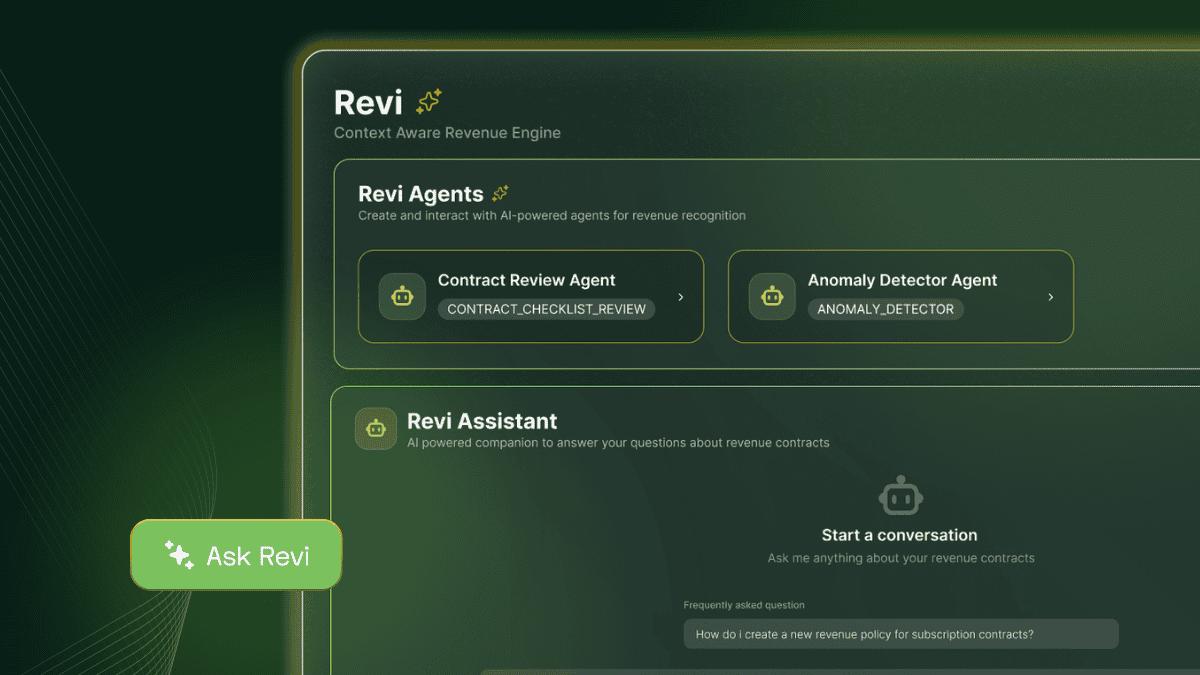
That belief is at the core of Revi, our new AI capabilities purpose-built for revenue recognition. Revi doesn’t start from a blank page. It operates within the full context of your revenue data, your accounting policies, your contract history, and the ASC 606 / IFRS 15 framework so that every insight, every automation, and every recommendation reflects how your company recognizes revenue.
If you’re exploring how AI can support your revenue recognition process, not as a generic tool, but as a context-aware extension of your team, we’d love to show you what Revi can do.
If you’re evaluating how AI fits into your revenue workflows, the question isn’t “Can AI analyze this?”
It’s: “Does this system understand the context behind my revenue?”
See how RightRev’s Revi AI brings that context into every decision and request a demo.
RightRev is the revenue recognition platform built for complex, high-volume environments. We help finance teams automate ASC 606 and IFRS 15 compliance, gain real-time visibility into revenue, and close books faster with the context and auditability that controllers and auditors require.