Revenue recognition is not a back-office compliance function anymore. It is the operational system that determines whether your next pricing model ships at product-team speed or stalls at finance-team speed, and for most B2B SaaS and AI software companies, that distinction is now a measurable growth variable.
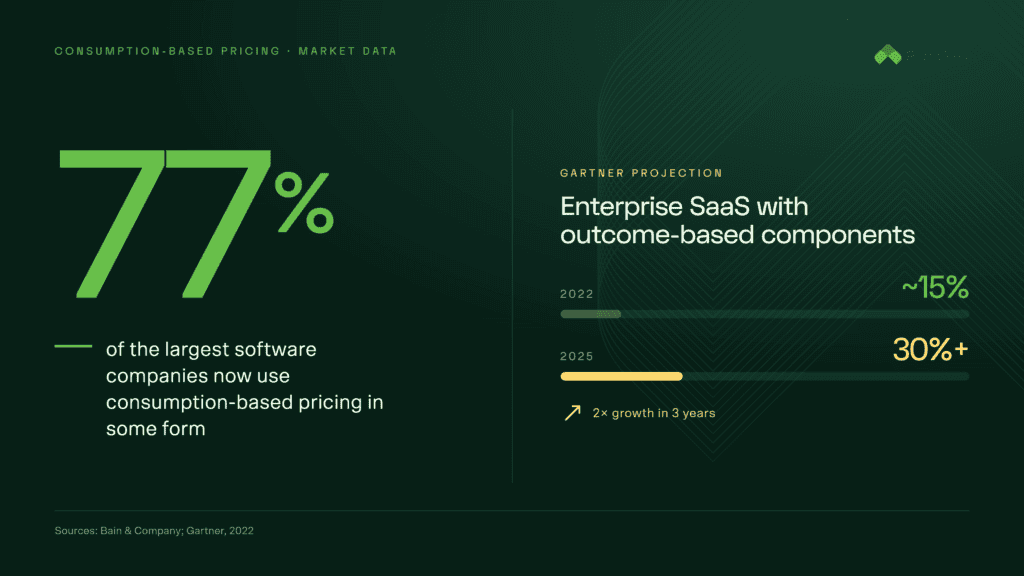
The pricing wave is not approaching. It has already arrived. 85% of SaaS companies already have or are actively building usage-based pricing, according to Metronome’s 2025 State of Usage-Based Pricing report. 43% of companies now combine subscriptions with usage-based components. 77% of the largest software companies now incorporate consumption-based pricing in some form. Gartner projects that 40% of enterprise SaaS offerings will include outcome-based components by 2026, up from roughly 15% in 2022, per NxCode
Every one of those pricing models is also a revenue recognition system and process challenge. The CFO whose rev rec engine cannot handle evolving monetization models is the CFO who delays the launch, downsizes the model, or skips it entirely, costing deals, compressing ACVs, and ceding ground to competitors who can move.
The Pricing Wave Is Already Here
That cadence has a direct implication for finance. When pricing models change that frequently, revenue recognition cannot be a one-time engineering project. It has to be a repeatable operational capability.
That cadence has a direct implication for finance. When pricing changes happen that frequently, the revenue recognition infrastructure underneath each model cannot be a one-time engineering project. It has to be a repeatable operational capability.
The commercial case for hybrid is already settled. Hybrid pricing is associated with meaningfully stronger revenue growth compared to single-model approaches, according to GrowthUnhinged’s 2025 data. Credit-based pricing models saw a 126% year-over-year increase in adoption across the PricingSaaS 500 index, growing from 35 to 79 companies in a single year. These are not experimental configurations. They are the commercial structures enterprise buyers are increasingly expecting, and that finance teams are being asked to support at launch, not after.
Pricing model velocity has become a core operating capability. For accounting leaders, the question is whether your revenue recognition infrastructure can keep pace with the rate at which your pricing team is iterating.
Why AI Pricing Is the Hardest ASC 606 Problem You Have Not Solved For
Outcome-based pricing stacks three hard ASC 606 judgments simultaneously
Legacy SaaS pricing, annual subscription, fixed fee, ratable recognition is structurally manageable under ASC 606. AI pricing is not. Outcome-based and AI agent consumption models introduce variable consideration, SSP allocation complexity, and performance timing ambiguity at the same time, in the same contract.
Variable consideration means revenue cannot be treated as a known amount at contract inception. The constraint analysis alone, determining how much variable consideration is highly probable not to reverse, requires judgment that must be documented, defensible, and updated as actuals come in.
SSP allocation becomes more complex when the contract bundles platform access, credits, implementation, premium support tiers, and an outcome-based success fee. Each element may represent a distinct performance obligation. Each requires an allocated transaction price based on standalone selling price. And each may have a different recognition pattern.
Performance timing adds the third layer. Finance must determine whether the customer is receiving value over time, at the point of consumption, or only when a specified outcome is achieved. For AI pricing, that determination is not always obvious, and the wrong answer creates a restatement risk, not just a disclosure footnote.
As EY’s analysis of SaaS transformation with GenAI notes, outcome-based pricing arrangements present additional complexities compared to legacy fixed-fee arrangements, requiring careful determination of performance obligation nature and evaluation of whether outcome-based variable fees can be recognized as incurred or must be estimated over the contract term.
Hybrid AI contracts create mixed recognition patterns manual processes cannot sustain
Consider a representative scenario: an AI workflow vendor sells a base platform subscription, bundled implementation services, monthly usage credits, and an outcome-based success fee tied to a measurable customer result. From a commercial standpoint, that is one deal. From an accounting standpoint, several distinct recognition schedules must remain tied to one contract and be recalculated every time the contract is modified.
Add-on agents, revised consumption thresholds, mid-term true-ups, and negotiated credits are common in AI contracts. Each can trigger reallocation or catch-up logic. As KPMG’s 2025 Handbook on Revenue for Software and SaaS notes, evolving business practices continue to create new challenges around performance obligation identification and transaction price allocation, and those challenges are most acute precisely where pricing innovation is moving fastest.
This is why hybrid pricing revenue recognition typically fails first in spreadsheets, then strains ERP-native revenue modules, and ultimately requires a purpose-built recognition engine to handle at scale.
Finance as Enabler or Bottleneck: The Decisive Variable
The rev rec constraint surfaces after the launch date is already set
Most companies do not discover the revenue recognition bottleneck when the pricing strategy is being designed. They discover it after product and sales have already aligned on a launch date, after the commercial terms have been drafted, and after the customer pipeline has been shaped around the new model.
At that point, finance faces three unattractive choices: delay the launch, reduce the pricing model to something the current system can handle, or go live with recognition logic that is not yet fully defensible. None of those outcomes is acceptable, but all three are common.
That cadence has a direct implication for finance. Revenue recognition infrastructure built for a single pricing model breaks the moment the model changes. Companies iterating on pricing quarterly need a recognition engine that can keep pace.
Product-team speed vs. finance-team speed is a measurable gap
Product-team speed means finance can evaluate a new pricing construct, model the recognition treatment, test edge cases across representative contract scenarios, and approve launch readiness in days. Finance-team speed (in the negative sense) means that every model change requires a spreadsheet redesign, custom ERP configuration, manual journal logic, or engineering support to reconcile billing and metering data before recognition can even be calculated.
The gap between those two speeds is measured in slower new product introductions, lost deals, compressed ACVs, and deferred monetization.
Your pricing team can design the model. Your revenue architecture determines whether it is commercially usable.
The pace of pricing iteration makes this more than a strategic question. PricingSaaS tracked more than 1,800 pricing changes across 500 top SaaS companies in 2025 alone. Lovable made roughly one meaningful pricing update per month, launching a Team plan, killing it, adding rollover credits, and adjusting price points across tiers. Salesforce launched AI credits, flexible payment options, a new user license, and an agentic ELA, all within a single calendar year. Each of those changes is also a revenue recognition event, requiring updated allocation logic, modified contract accounting, and revised disclosure positions. Finance teams running on spreadsheets or ERP-native modules do not have the infrastructure to keep pace.
Why Consumption Pricing Gets Simplified Before It Ever Ships
The common compromise is not delay alone, it is downgrading the commercial model
A company that intended to launch consumption pricing with dynamic tiers, usage-based overages, and an outcome-based success fee often ends up shipping a flat-rate annual subscription. Not because the pricing strategy was wrong. Because recognition could not be operationalized before the quarter-end deadline.
That compromise changes the economics of the deal in ways that are easy to underestimate. Upside is capped at contract signing rather than expanding with usage. Expansion revenue becomes harder to capture because the pricing structure does not reflect actual consumption. The contract may close for a shorter term or lower ACV than originally intended because the customer has no incentive to commit to volume they cannot yet predict.
A concrete version of this: a 3-year consumption commitment, with meaningful expansion potential built into the pricing model, is negotiated down into a 1-year flat subscription because finance cannot support the recognition model before the quarter closes. The deal closes. The monetization ceiling is permanently lower, and the expansion path is gone.
The opportunity cost compounds each quarter
Each quarter a higher-fidelity pricing model is delayed is a quarter of lost monetization, deferred expansion revenue, and weaker pricing data for future iterations. If a new usage model is expected to lift average contract value by 20 to 30%, a two-quarter delay is not project slippage. It is a deferred ARR opportunity with a calculable dollar figure.
The commercial stakes are higher in AI pricing specifically. Bessemer Venture Partners’ AI Pricing and Monetization Playbook notes that the market is moving from selling AI potential to charging for delivered value, and companies that can ship outcome-based pricing, now are setting the commercial terms that others will later follow. First movers in pricing model sophistication establish the ceiling for the category. Slower operators cede pricing power as well as revenue.
SEC Disclosure Risk Begins the Quarter a New Pricing Model Goes Live
Launching without defensible recognition logic turns product innovation into disclosure exposure
SEC comment letter activity around variable consideration disclosures, contract modification accounting, performance obligation identification, and revenue disaggregation has remained elevated since ASC 606 adoption and has continued to increase as pricing models grow more complex. That matters because a new AI or hybrid pricing model becomes a disclosure issue in the next 10-Q, not only in the next audit cycle.
If recognition logic is still being interpreted after launch, the company is effectively learning its accounting position in public. That is a different risk profile than a delayed launch. It is a disclosure risk that compounds with each reporting period until the position is fully documented and defensible.
Usage-based pricing revenue recognition and outcome-based pricing ASC 606 judgments need to be documented before commercial rollout, not retrofitted after the first quarter of actuals.
Pre-IPO companies have less room for recognition ambiguity
For companies within 18 months of IPO, the standard is whether the model is repeatable, auditable, and disclosure-ready now. Before the S-1 process begins, before auditors are reviewing revenue schedules under heightened scrutiny, and before investor trust is on the line.
Inconsistent revenue recognition logic damages investor confidence more durably than a conservative launch timeline. Inconsistent revenue recognition logic damages investor confidence more durably than a conservative launch timeline. The goal is a RevRec architecture that allows speed with control, launching the intended model, on schedule, with recognition logic that holds up from day one
If pricing innovation changes what you promise, how you bill, and when value is delivered, it also changes what you must prove to auditors and the market.
What Pricing Velocity Actually Requires from Your RevRec Stack
Pricing velocity is an operational capability, and it requires specific architectural conditions in your revenue recognition stack.
Finance needs a flexible recognition engine that can configure new pricing models without custom engineering every time pricing changes. The ability to test recognition scenarios before launch, including SSP allocation outcomes, variable consideration treatments, modification logic, and revenue timing by performance obligation, is not optional for AI and hybrid models. It is the minimum bar for a defensible launch.
The system must connect billing, CRM, ERP, and product metering data so recognition reflects actual contract structure and actual consumption, not a manual approximation assembled at close. And it must produce audit-ready schedules, revenue waterfalls, and full traceability from contract event to recognized revenue because speed without evidentiary support is not useful to a CFO, an auditor, or an SEC reviewer.
Most tools handle billing well. Some handle simple revenue recognition. The gap that determines pricing velocity is the ability to rapidly configure, test, and deploy recognition logic for any pricing model without bespoke engineering, without launch delays, and without compromising the compliance depth that makes the position defensible.
RightRev is built for recognition depth at pricing-model speed
RightRev is the revenue recognition engine built specifically for companies undergoing pricing model transitions: usage-based, outcome-based, hybrid bundle, AI agent consumption, and multi-entity revenue share. The platform is designed to configure and deploy new recognition logic quickly, without requiring custom engineering for each new model, and with audit-ready traceability from day one of launch.
For companies evaluating a pricing change, the relevant question is not whether your current system can handle the model you have today. It is whether it can handle the model you want to launch next quarter, at the speed your product and sales teams are moving.
The Bottom Line
Your revenue recognition architecture determines whether your pricing strategy is commercially executable at the speed the market now requires. Every modern pricing model carries a revenue recognition design problem inside it.
For most companies, the real constraint on AI monetization speed is RevRec infrastructure, not pricing ambition. Finance teams that can configure and defend recognition logic quickly gain both commercial velocity and disclosure confidence, and the CFO who can say yes at product-team speed becomes the most commercially valuable person in the building.
If you are evaluating a pricing model change or approaching an IPO within the next 18 months, the time to assess your RevRec architecture is before the launch date is set, not after.
If your pricing roadmap is moving faster than your recognition infrastructure, Request a Demo to see how RightRev handles the model you want to launch next quarter . Or explore the Revenue Recognition Buyer’s Guide to understand what pricing velocity actually requires from a purpose-built recognition engine.
Frequently Asked Questions
What is consumption-based pricing and how is it different from subscription pricing?
Consumption-based pricing charges customers based on actual usage of a product or service, such as API calls, compute hours, or data volume. Subscription pricing charges a fixed recurring fee for access regardless of usage. From a revenue recognition standpoint, consumption models require variable consideration treatment, whereas subscriptions are typically recognized ratably.
What are the most common SaaS accounting compliance challenges under ASC 606?
Common challenges include correctly identifying and separating performance obligations in bundled deals, determining and documenting standalone selling prices, handling contract modifications from upgrades and downgrades, accounting for variable consideration from usage tiers, and managing the volume of contracts at scale without automation.
What should CFOs know about revenue recognition automation before evaluating software?
CFOs should understand that revenue recognition automation is not just a compliance tool but a strategic finance investment. The right platform reduces close cycle time, improves audit readiness, enables real-time revenue visibility, and scales with business complexity. The evaluation should include total cost of ownership, integration requirements, and the ability to support new business models like usage-based pricing.
References:
↗ Metronome — State of Usage-Based Pricing 2025 (Report)
↗ Chargebee — 2025 State of Subscriptions (Report)
↗ Flexera — From Seats to Consumption: Why SaaS Pricing Has Entered Its Hybrid Era (Article)
↗ KPMG — Handbook: Revenue for Software and SaaS 2025 (Handbook)
↗ EY — SaaS Transformation with GenAI: Outcome-Based Pricing (Article)
↗ Bessemer Venture Partners — The AI Pricing and Monetization Playbook (Report)
↗ Deloitte — CFO Guide to Tech Trends 2026 (Report)
↗ Growth Unhinged / PricingSaaS — 2025 State of SaaS Pricing Changes (Article)
↗ Orb — SaaS Revenue Recognition: ASC 606 Compliance 2025 (Article)
↗ PwC — Five Revenue Recognition Challenges SaaS Companies Can’t Ignore (Article)
↗ TSIA — AI Pricing Models: Usage-Based, Outcome-Based, and Hybrid (Article)