Every finance team is being asked to automate more. Fewer have a clear rule for what to automate first, when to build versus buy, and what to leave alone. In a recent CFO Brew webinar sponsored by RightRev, two finance leaders shared how they make that call.
Adriana Carpenter, CFO of Xactly, shared when her team builds versus buys, why compliance changes the answer, and how finance stays ahead of AI-driven change in other departments. Jagan Reddy, founder and CEO of RightRev, then applied the same discipline to revenue recognition, where accuracy and auditability are not optional.
Here is what controllers, CFOs, and revenue accountants can take from the conversation.
Prefer to watch? The full conversation, Where the Buck Actually Stops: Avoiding the Automation Ceiling, is available on demand. Watch the webinar on CFO Brew.
Build vs buy: complexity and compliance draw the line
Adriana’s rule of thumb is simple. Low-risk, easy-to-maintain tools get built internally. Anything complex or compliance-heavy gets bought.
On the build side, one of her accountants used an AI assistant to automate a monthly budget vs actuals outlier check during close. It replaced a manual process and was simple enough to own.
The buy side came from usage telemetry. Her team started building a model to measure product usage, then realized that data could feed revenue recognition. That raised the bar for controls, accuracy, maintenance, and redundancy.
“You don’t want one person who is the only person that knows how to manage this particular agent that does this one thing, and nobody else knows how to do it. And if it breaks, now you’re sort of left there. And guess what? Now I can’t recognize revenue.”
The team pivoted to an off-the-shelf solution because, in her words, someone else had already built in the checks and balances.
For a deeper look at this tradeoff, see our guide to build vs buy for revenue recognition.
The same logic applies to the reporting itself. Her team is replacing Excel reporting with real-time dashboards that combine financial and operational data. Rather than build alone, they brought in a third party to build the dashboards and train the team to maintain them.
Slow down before you speed up
Early in the year, teams across Adriana’s company were adopting AI tools on their own. Finance called a timeout to set guardrails and define target metrics before anything scaled.
“We need to actually slow down before we speed up.”
One example: a marketing team aimed to cut digital campaign build time from four weeks to one. With that target set up front, finance can check cost before and after, velocity, and the effect on pipeline.
The same metrics tell you when to stop. If an agent takes longer to QC, tweak, and retrain than the old process took, Adriana says it may be time to admit it is the wrong path for that use case.
Finance has to show up as a business partner
As marketing, engineering, and support adopt AI, a budget vs actuals conversation is no longer enough. Finance partners need to understand what each function is changing and what it does downstream to pipeline, product velocity, and the top line.
“If you don’t understand what they’re changing… you’re going to be kind of left almost like behind the scenes, like you’re one step behind. You’ve got to be in front.”
For annual planning, Adriana starts with business priorities such as revenue growth, margin expansion, or geographic expansion. Then she ranks AI investments by where they deliver the biggest impact against those goals.
Her one question for any CFO before approving an automation project is to understand the why and draw a measurable line. Sitting at the center of the business also means catching conflicts.
“These five teams are off doing these five things, but guess what? Two of these things are completely at odds with one another.”
Revenue recognition example: a demo is not a controlled process
Jagan Reddy has spent his career on revenue complexity. Before RightRev, he founded Leeyo Software, which Zuora acquired. He sees the same gap Adriana described: finance has automated tasks, but not whole processes.
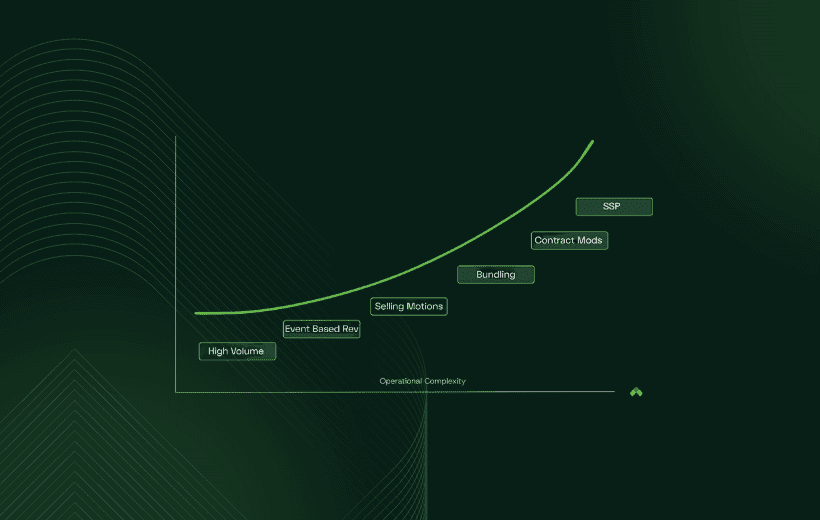
Revenue recognition is a clear example. A company can run modern CRM, billing, and ERP systems, and accountants still pull data from all three into spreadsheets. Usage pricing, bundles, and contract changes make that harder every quarter.
Jagan’s advice is to evaluate three layers separately:
- The data feeding the process
- The accounting logic applied to it
- The way people interact with the system
AI is changing the third layer fast. It helps people investigate exceptions, understand results, and act. It cannot fix the first two.
“A better interface cannot compensate for incomplete data or incorrect accounting logic… Don’t confuse an impressive AI demonstration with a controlled financial process.”
For revenue calculations, he wants an engine that applies approved rules consistently, with AI helping the team work around it and people keeping responsibility for judgment.
Three questions before you automate
Jagan gave CFOs a short framework for deciding where to automate first.
- Where is the pain greatest? Look for work that repeats, consumes real effort, and delays other teams. Reconciliations, revenue allocations, and recurring spreadsheet adjustments are good candidates.
- How ready are we to automate it? Check whether you can access the data, whether the rules are understood, and whether you can identify the exceptions that need human review.
- How quickly can we prove the results? Set a baseline: hours spent, adjustments required, time to close, or how long finance takes to evaluate a new deal structure.
“A painful process with accessible data and clear rules is often a strong starting point.”
Start with the measurable problem, prove the value, then expand.
What you sold is not what gets recognized
Take a contract with a software subscription, an implementation service, and usage charges, where the customer upgrades halfway through the term. Billing tells you what was invoiced. It does not tell you how much revenue to recognize in each period.
Finance still has to identify performance obligations, allocate the transaction price, and recognize revenue as each obligation is satisfied. Contract changes can shift all of it.
“I always say this, what you sold is not what gets recognized.”
RightRev brings the transaction data together and applies the accounting policies the finance team configures. Its deterministic engine handles ASC 606 and IFRS 15 allocations and revenue schedules, with traceability back to the underlying transactions. RightRev is now adding data mediation, context, and agent capabilities on that foundation.
The stakes rise as pricing gets more creative. Picture an AI company selling an annual subscription with included usage credits, discounted overage rates, and a mid-year upgrade option. If sales and billing can support that offer but the accounting process cannot, finance rebuilds each contract from multiple sources in spreadsheets.
“I sometimes call that a finance tax on innovation. Every new offer adds another layer of manual work.”
In Jagan’s view, a pricing model is ready to scale only when the company can sell it, bill it, and account for it reliably.
What changes when the process changes
The first visible wins are usually less manual work and a faster close. Jagan argues the process changes behind them matter just as much. Teams validate transactions and work exceptions during the period instead of discovering gaps at month end. They review results instead of rebuilding spreadsheets.
That gives FP&A more timely forecasting inputs, management earlier visibility into revenue, and the deal desk a better basis for evaluating complex terms. It also lets finance support higher transaction volume without adding manual work at the same rate.
Jagan judges success at three levels: effort saved, stronger control over the process, and faster business decisions.
The common thread
Both speakers landed in the same place. Define the outcome, build on trusted data and logic, measure as you go, and be willing to pivot.
“Make sure you have truly an outcome in mind and be measuring your progress along the way so that you know whether you’re succeeding or not.” (Adriana)
“Accountants still bring the judgment. Automation gives them more time to apply it.” (Jagan Reddy)
Want to hear the full conversation? Watch the webinar on demand.
If your team is still reconstructing contracts in spreadsheets every close, talk to RightRev about where to start.