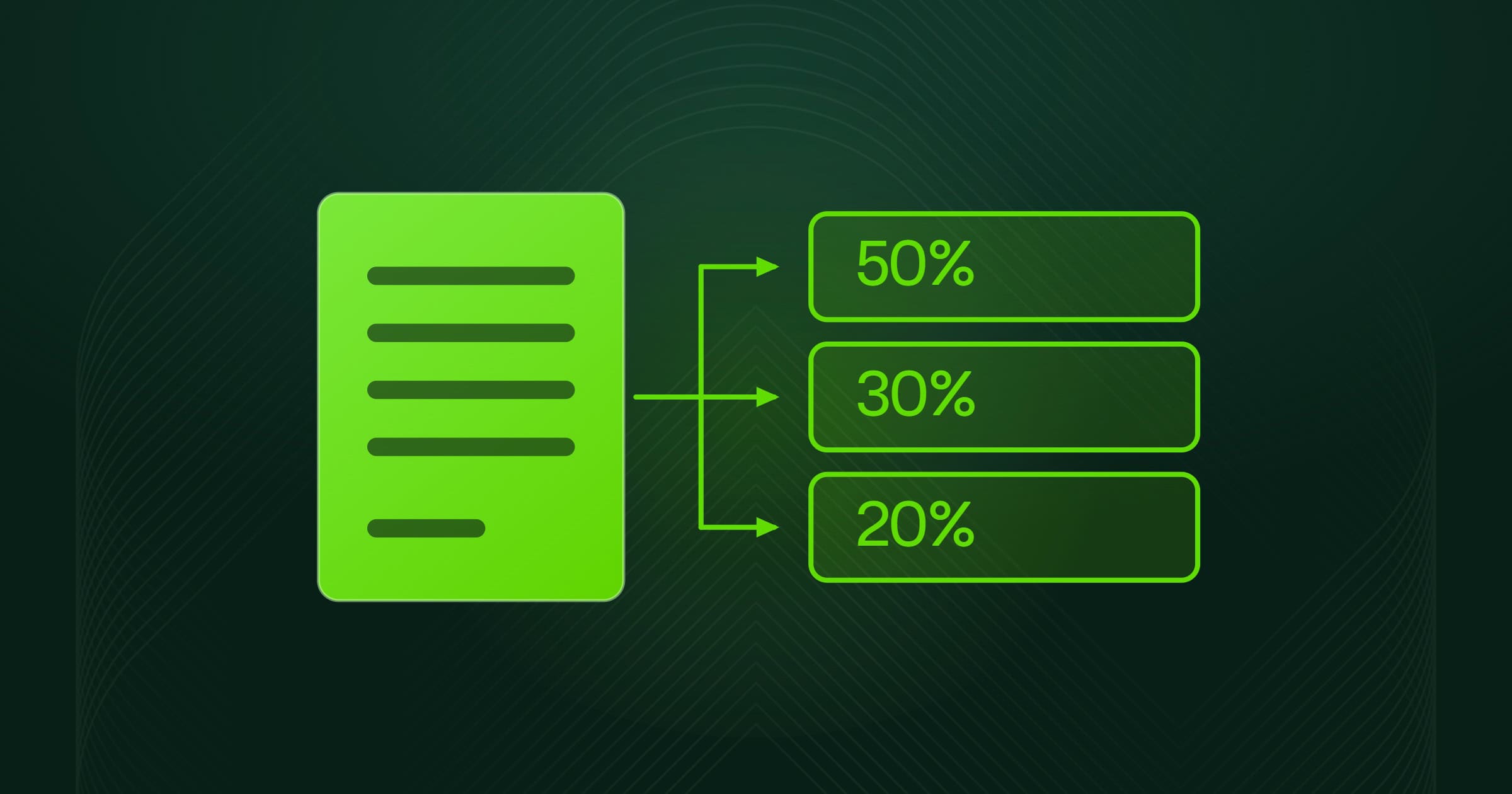
Direct answer: Evaluating SSP allocation software in 2026 means testing four things: whether the system calculates SSP itself from transaction data instead of only storing a number finance already worked out, whether it supports SSP as a range or formula instead of one fixed value, whether it recalculates correctly at contract modification, and whether it exports a defensible audit trail.
Every revenue recognition vendor claims to handle standalone selling price allocation. Almost none mean the same thing by it.
Evaluating SSP allocation software in 2026 means testing four specific capabilities. Whether the system can determine SSP itself by analyzing historical transaction data, rather than only accepting a number finance already calculated in a spreadsheet and applying it. Whether the platform can express SSP as something more sophisticated than one fixed number per product, a range, a formula weighing multiple factors, or an uploaded and finance-approved policy, instead of forcing every line item into a static rule. Whether it keeps that allocation correct automatically as contracts change instead of breaking down at the first amendment. And whether it produces a defensible, exportable audit trail for how each SSP was derived.
This piece is the SSP-specific companion to How to Evaluate Revenue Recognition Software. Where that guide covers the full evaluation framework, this one narrows to a single capability that separates vendors more than any other: what the system actually does when a bundle has no observable price, a contract changes mid-term, or an auditor asks how a number was derived.
Revenue accountants typically discover the gap at one of those three moments. By then, the evaluation is over and the system is already in production.
For the underlying concept, see RightRev’s standalone selling price hub. For the operational cost of doing this manually, see Automating SSP Without Losing Months and Quarters in Analysis.
Does the Vendor Actually Support SSP Allocation, or Just Claim It?
“Supports SSP allocation” is not a useful evaluation criterion on its own. The question is what the system does at the edges, because that is where ASC 606 compliance claims get tested.
SSP allocation is step four of the ASC 606 five-step model: allocating the transaction price across performance obligations in proportion to standalone selling price, not in proportion to negotiated deal structure. For contracts where every element is sold separately at a consistent price, this is straightforward. Most software handles it adequately.
The complexity starts with bundles. When a good or service is not sold separately, there is no observable SSP, and the accounting team must estimate one using a documented methodology. The estimation method has to be appropriate for the product, consistently applied, and defensible when an auditor asks why that method was chosen over the alternatives. Software that cannot support that judgment workflow is not automating SSP allocation. It is automating the easy portion and leaving the hard part in a spreadsheet.
Manual SSP analysis compounds this problem at scale. According to RightRev’s published analysis, accounting teams routinely spend months or entire quarters on annual SSP research and calculation when the work lives in spreadsheets. That is the operational cost that software should be evaluated against, not a feature checklist.
Two recurring errors appear in manual and semi-automated environments in 2026: applying stale SSP estimates that have not been updated since the last annual review, and allocating discounts based on deal negotiation logic rather than proportional SSP allocation across all performance obligations. Both are audit exposure points. Both are preventable with the right system architecture.
Can the Platform Handle SSP as a Policy, Not Just a Fixed Number?
This is one of the clearest differentiators between vendors, and it matters more than which methods a system technically supports. Most systems assume finance has already determined the SSP value outside the platform, in a spreadsheet, a pricing memo, or a static price list, and only need a place to store that number and apply it consistently. Fewer platforms can perform the underlying calculation themselves: ingesting historical transaction data and deriving the SSP, or SSP range, directly, rather than waiting for finance to hand over a predetermined figure.
Most software can apply a static rule, this product’s SSP is $5,000, full stop. Fewer can treat SSP as something more variable: a range instead of one fixed value, a formula that weighs multiple factors at once (list price, deal size, term, region), or a policy built from uploaded, finance-approved data rather than a hardcoded assumption. Fewer still can apply SSP that depends on more than one criterion simultaneously, where the governing policy changes based on customer, product family, and deal structure all at once.
Software that can only encode single fixed values forces exceptions, manual overrides, and policy drift into the process the moment real pricing gets more complicated than a price list. Those workarounds accumulate and get harder to defend as the product catalog evolves.
Test this directly in a demo: present a mixed bundle with at least one element sold at a consistent price and one that requires estimation, and ask the vendor to show how SSP is expressed as a range or a formula rather than a single number, and how that configuration is documented. SSP policy can also be configured to vary by dimension, by customer, by product line, or by contract type, for arrangements where a single policy genuinely doesn’t fit. When evaluating this, ask whether hierarchy configuration requires custom scripting or professional services, and how the system resolves a conflict when more than one dimension could apply to the same line item.
What Does a Formula-Based SSP Policy Actually Look Like?
A worked example makes this concrete. Take a single software line item with a list price of $25,000. Rather than a hardcoded dollar figure, finance has configured the SSP policy for this product family as a formula, transactional list price multiplied by 73%.
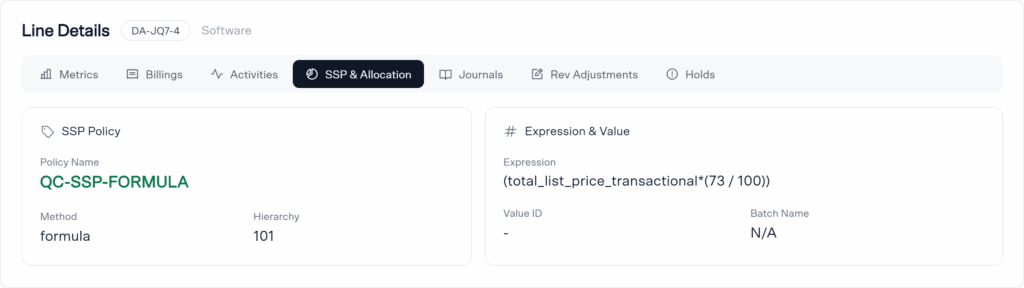
That formula alone puts the derived SSP at $18,250, the midpoint. But a fixed midpoint has the same problem as a fixed number: it assumes every deal for this product lands in exactly the same place. So the policy also carries a floor and ceiling, 4% on either side, producing a usable range rather than a single output.
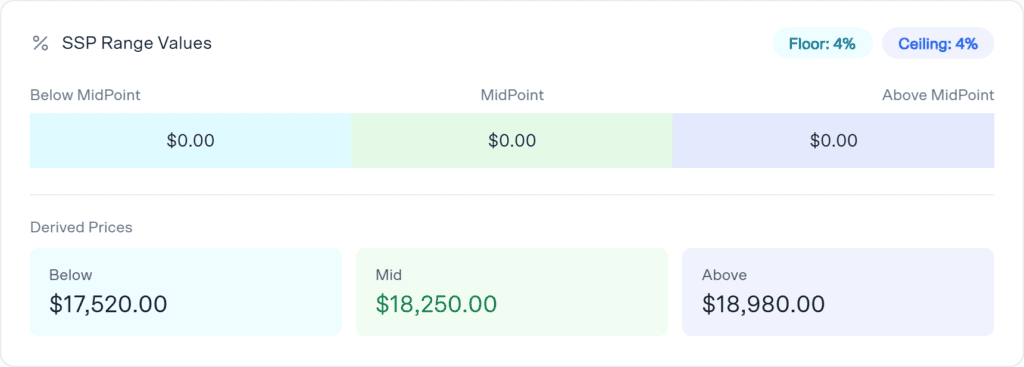
For this particular contract, the negotiated sell price came in at $19,333.33 against the $25,000 list, and the applied SSP landed at $18,980, the top of the configured range.
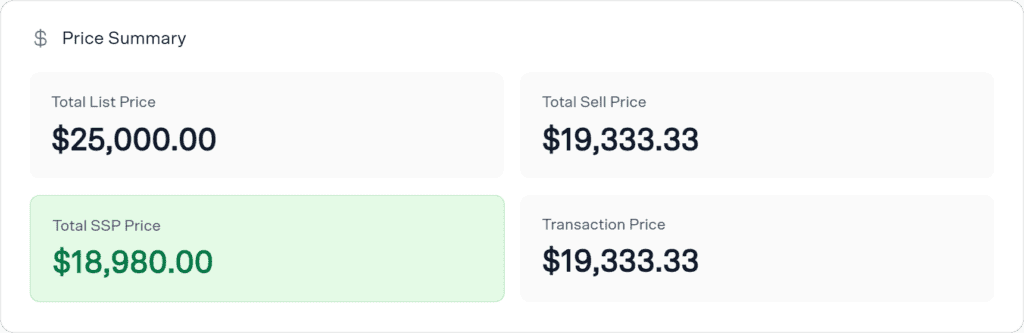
The specific dollar figures aren’t the point. What matters is that the policy, the formula, the range, and the resulting derived price are all visible and traceable, which is exactly the workpaper detail an auditor should be able to pull for any line item, not just this one.
How Does the Software Handle SSP Allocation at Contract Modification?
This is the single most common point where manual and semi-automated systems break. It is also the capability that separates vendors who have built a genuine recognition engine from those who have built a sophisticated billing integration.
Does It Distinguish Inception-Date SSP from Current-Date SSP Correctly?
The accounting rule is specific. When a contract modification is not a separate contract, the transaction price is reallocated to remaining performance obligations using current-date SSPs. Satisfied obligations remain tied to inception-date SSP. The impact on already-satisfied obligations is a cumulative catch-up; the impact on unsatisfied obligations is prospective.
Many systems claim modification support but treat SSP as a static lookup. Once an upgrade, add-on, downgrade, or renegotiation changes the economics of the remaining contract, those systems either apply the wrong SSP vintage or require manual intervention to recalculate. The unit of account should be the contract and its remaining performance obligations, not the latest invoice line.
Software that cannot make this distinction is not automating SSP allocation at modification. It is automating the initial allocation and leaving the modification accounting to a spreadsheet.
Can It Apply Cumulative Catch-Up and Prospective Treatment Based on Modification Type?
The practical evaluation question is whether the platform distinguishes separate contract treatment from modification of the original contract, then applies the resulting accounting treatment automatically.
This is arguably the most operationally important test in this entire evaluation. A quantity increase on an existing contract should trigger a prospective SSP allocation adjustment automatically. A quantity decrease should trigger a retrospective recalculation, also automatically. Prospective, retrospective, and cumulative catch-up treatment all need to work without manual journal entries or a detour through a spreadsheet, and without breaking the standard revenue schedule for the rest of the contract. Suite-based ERP add-ons that bolt revenue recognition onto a broader billing module are the ones most likely to struggle here; confirm in the demo how much of this is genuinely automatic versus how much still depends on someone remembering to run a manual recalculation.
This is where the calculation gap described earlier compounds. A system that never determined SSP itself, and only stores a number that finance handed it, has no basis for recalculating that figure when volume, mix, or deal structure changes mid-contract, it can only re-apply the same static input, which quietly breaks the allocation logic ASC 606 requires. A platform that calculates SSP from underlying data can revisit that calculation at the modification date and produce a defensible current-date SSP, not just re-run the same number against a new quantity.
Ask the vendor to demonstrate how the system books a cumulative catch-up for satisfied obligations where required, while simultaneously applying prospective revenue schedules to remaining obligations. If the answer involves offline journal entries or a manual recalculation step, the automation is partial. At 50 contracts, partial automation is manageable. At 300 or more contracts with frequent modifications, it is a material control risk.
What Should You Test in a Proof of Concept for SSP Reallocation?
Use a contract from your own environment, not the vendor’s canned demo data. Specifically, use one with a non-uniform discount, a bundled arrangement where at least one element has no observable SSP, and a mid-term change that affects only part of the arrangement.
Require the vendor to show the original allocation at inception, the modification-date reallocation using current-date SSPs, the journal entry impact, and the updated revenue schedules for remaining obligations. If any step in that sequence requires manual input or produces output that cannot be traced back to the system’s own logic, document that gap before the evaluation concludes.
This mirrors the broader principle from the parent evaluation piece: canned demo data rarely exposes where SSP logic actually breaks. Your ugliest real contract will.
Can the System Produce an SSP Audit Trail an Auditor Can Actually Test?
What Should an Exportable SSP Workpaper Contain?
The minimum evidence set for a defensible SSP determination includes the estimation method used, the data inputs behind it, the assumption range, the effective date, the product or service line mapping, and the resulting allocation by performance obligation. An audit-ready workpaper is exportable and traceable, not locked in a system interface or reconstructed manually after the fact. The formula, range, and derived price shown earlier for the $25,000 software line item is the shape that evidence should take for every line item, not just one.
Historical versioning matters here. SSPs should be reassessed at least annually, and more frequently when pricing changes rapidly, product packaging shifts, or new offerings are introduced. The system should preserve prior versions with effective dates so that an auditor can verify what SSP was in effect at any given contract inception date and why it changed.
Why Does Audit Trail Depth Matter More in 2026?
Revenue recognition ranked among the top five SEC comment letter topics in both 2024 and 2025, according to RevenueHub’s analysis of recent SEC comment trends published in February 2026. The SEC’s Enforcement Division launched a Financial Reporting and Accounting Unit on August 5, 2026, naming revenue recognition as a specific focus area and pairing accountants with attorneys to examine the judgment behind reported numbers. RightRev has covered this enforcement context in detail here.
SSP allocation judgment calls are exactly the kind of “judgment behind a number” that unit is built to scrutinize. A screenshot from a vendor demo is not evidence. Finance should ask how an SSP determination can be reproduced, with full supporting documentation, six months after the fact.
How Should Finance Evaluate AI-Driven SSP Claims Without Lowering the Control Standard?
Several vendors now position AI as the mechanism behind SSP calculation. The evaluation standard does not change because the method is AI-driven.
AI assists with everything around the calculation. It never touches the calculation itself. That line holds for SSP the same way it holds everywhere else in revenue recognition. Ask how the system ensures repeatability, policy governance, and explainability for SSP calculation in production, not only how quickly it generates a result in a demo environment.
The relevant buyer question is whether finance can review, test, and approve SSP logic before it affects revenue schedules. Automation should execute accounting judgment consistently, not substitute for it. A system that produces an SSP number without a documented, reviewable methodology is a close convenience, not an audit-grade control.
How Do Revenue Recognition Software Categories Compare on SSP Allocation?
The table below reflects typical fit based on vendor positioning and customer profile, not a scored ranking. Every vendor’s capabilities evolve, and every buyer should verify against its own contract structures, data environment, and close process before drawing conclusions.
| Vendor | Typical Fit | SSP Method Flexibility | Modification Handling | Audit Trail Depth | Key Demo Validation |
|---|---|---|---|---|---|
| RightRev | Complex multi-element contracts with bundled licenses, services, or hardware; frequent modifications | SSP Calculator analyzes historical transactions for the common case; supports SSP as a range, a multi-factor formula, or uploaded policy data for advanced or variable pricing, configurable per product line | Automatic re-allocation on modification; cumulative catch-up and prospective treatment applied based on modification type | Full exportable workpaper per determination; historical versioning | Mixed-method bundle plus mid-term modification using your own contracts |
| NetSuite ARM | Businesses already committed to NetSuite as the ERP of record | SSP handling bundled into the broader ARM module; method flexibility depends on configuration depth | Modification support exists within ARM; confirm how much requires manual journal entry versus systematic recalculation | Tied to NetSuite’s native reporting; exportability depends on report configuration | Mixed-method bundle plus mid-term modification using own contracts |
| SAP Revenue Accounting and Reporting | Large multinational enterprises already on SAP with complex multi-GAAP requirements | Deep methodology support across frameworks; configuration complexity is high | Robust modification handling at enterprise scale; implementation scope is significant | Extensive audit documentation capability; requires proper configuration to surface it | Confirm whether SSP configuration requires SAP consulting resources or can be maintained by finance |
| Hubifi | High-transaction-volume, usage-heavy businesses where data aggregation is the primary challenge | SSP allocation is secondary to data ingestion and real-time analytics; confirm depth of estimation layer | Confirm how modification accounting is handled once contracts require policy-driven reallocation | Audit trail depth should be validated specifically for SSP determinations, not just transaction volume | Ask how the system handles a bundle with no observable SSP for one element |
| Tabs | B2B companies with low to medium complex contract terms, escalators, usage tiers, or milestone structures | Contract term extraction is a strength; confirm how extracted pricing terms convert into governed SSP policy | Confirm whether modification detection triggers SSP reallocation automatically or requires manual review | Validate that extracted terms produce an auditable allocation, not just a parsed contract summary | Test a contract with a non-uniform discount and ask to see the resulting allocation workpaper |
| Campfire | High-growth tech companies replacing small-business accounting systems with a full ERP | SSP allocation is one part of a broader accounting overhaul; evaluate as a finance architecture decision | Confirm modification handling depth as part of the broader system evaluation | Audit trail should be evaluated across the full accounting stack, not SSP in isolation | Assess SSP capability alongside the full close process, not as a standalone feature |
| Maximor | Companies seeking an ERP-agnostic automation layer with faster deployment timelines | Automation layer sitting on top of an existing ERP; confirm how much native SSP logic exists versus reliance on the underlying system | Key evaluation issue is whether modification accounting and SSP reallocation are handled natively or passed back to the ERP | Audit evidence should be validated for SSP specifically, not just workflow automation generally | Ask what happens to SSP audit trail if the underlying ERP changes |
How Does RightRev Handle SSP Allocation?
The evaluation framework in this article reflects what a production-grade SSP allocation capability actually requires in 2026. RightRev was built around a slightly different premise than most of the vendors discussed above: the hard part of SSP isn’t picking a method, it’s operationalizing a policy that’s genuinely as variable as real-world pricing, and keeping it correct as contracts change.
For the common case, RightRev’s SSP Calculator analyzes a company’s own historical transaction data, plots it as a distribution, and recommends an SSP based on where the bulk of actual deals cluster. That is a meaningfully different starting point than software that only accepts an SSP value finance already worked out elsewhere and applies it consistently, RightRev performs the underlying analysis itself, rather than waiting for a number to be handed to it. Finance reviews and approves the recommendation before it goes live.
AI assists with everything around that calculation, surfacing the recommendation, flagging outliers in the underlying distribution, drafting the supporting documentation. It never touches the calculation itself. The recommendation goes to finance for review and approval before it affects a single revenue schedule.
For situations where a single fixed value doesn’t reflect reality, RightRev supports SSP expressed as a range rather than one number, formulas that weigh multiple factors, and uploaded, finance-approved policy tables, so a genuinely variable pricing policy doesn’t have to be flattened into a static rule just because the software can’t handle anything more complex. SSP policy can also be configured by customer, product, or contract dimension in arrangements that call for it.
Where this tends to matter most in practice is what happens after the deal is signed. When a contract quantity increases, RightRev adjusts the SSP allocation prospectively, automatically. When a quantity decreases, it recalculates retrospectively, automatically. Prospective, retrospective, and cumulative catch-up treatment are all handled without manual journal entries or a detour through a spreadsheet, whether the entire multi-element contract is affected or only one line item changes.
For finance teams that need to test recognition logic before it hits production, RightRev’s Revi Architect lets teams design and validate SSP allocation rules against a shifting pricing model, so the audit trail holds up when contract terms change mid-period. More detail on that capability is available on the Revi AI product page.
RightRev was named a Leader by MGI Research, a credential worth weighing alongside any vendor’s own SSP claims in this evaluation.
The revenue recognition system page covers the full SSP allocation feature set in detail.
The real test of SSP allocation software in 2026 is not whether a vendor checks the box. It is whether the system can operationalize a pricing policy as complex as the business actually needs, keep applying it correctly through contract changes without manual intervention, and leave a clear, exportable audit trail behind every number. Those three criteria are where the evaluation should be concentrated, and where the differences between vendors become concrete.
If you want to evaluate SSP allocation logic against your own contract complexity rather than a vendor’s demo environment, RightRev’s Revenue Complexity Assessment is an 11-question diagnostic that maps your contract structures, pricing models, and modification patterns against what a production recognition system needs to handle. Or, if you’d prefer to work through a specific scenario directly, request a demo and bring your most complex bundle.
Frequently Asked Questions
What triggers a contract modification under ASC 606?
A contract modification occurs when the parties to a contract approve a change that creates new, or changes existing, enforceable rights and obligations. Depending on whether distinct goods or services are added at standalone selling price, a modification is accounted for as a separate contract, a termination of the old contract and creation of a new one, or a cumulative catch-up adjustment to the existing contract.
What are the most common SaaS accounting compliance challenges under ASC 606?
Common challenges include correctly identifying and separating performance obligations in bundled deals, determining and documenting standalone selling prices, handling contract modifications from upgrades and downgrades, accounting for variable consideration from usage tiers, and managing the volume of contracts at scale without automation.
What is the difference between a revenue recognition module in an ERP and a dedicated revenue recognition platform?
ERP revenue modules are add-ons built within the ERP’s data model, often constrained by its transaction structure. Dedicated revenue recognition platforms are purpose-built to handle the full complexity of ASC 606, including contract management, SSP allocation, modification accounting, and sub-ledger reporting, with deeper flexibility and auditability than ERP modules can typically provide.