
Defensible revenue is revenue a company can explain, obligation by obligation and change by change, to an auditor, an investor or a board on any day it is asked. Companies now carry at least three versions of revenue: ARR, GAAP revenue and cash. The gap between them matters less than whether anyone can explain it. Revenue becomes defensible when it is derived by rule, the same way every time, and traceable to its source.
Sooner or later, someone asks which of a company’s revenue numbers is the real one. It might be a director reading the board deck, an investor in diligence, a lender, or an auditor at year end. The question is fair, because a company’s topline now comes in at least three versions: ARR and its cousins, GAAP revenue, and cash. The OnlyCFO newsletter described them this way: “ARR is a hope, GAAP revenue is a judgment, and cash is a fact.”
When the question comes, the size of the gap between the numbers matters less than whether anyone can explain it. A gap with an explanation is a footnote. A gap without one introduces doubt, and doubt does the damage. Many boards have never seen the three reconciled, and many finance teams could not produce the reconciliation on short notice.
The places where the revenue number breaks have been the same for a long time: the contract change nobody told accounting about, the bundle priced one way and booked another, the spreadsheet only one person understands. What has changed is how quickly those places multiply, and how many automated systems, including the AI agents finance teams are now deploying, depend on the number being right. An agent is only as trustworthy as the number it starts from.
What follows covers why that number matters more now than it did five years ago, the two reasonable assumptions that leave it exposed, and a test any CFO can run with their controller this week.
Your most important number is also your most exposed
Revenue is the number every other number leans on. It sets valuation. It drives compensation plans and forecasts. It is the first line lenders and acquirers test, and it is now the input for the AI agents finance teams are putting to work. If revenue is wrong, or right but impossible to explain, everything built on it inherits the problem.
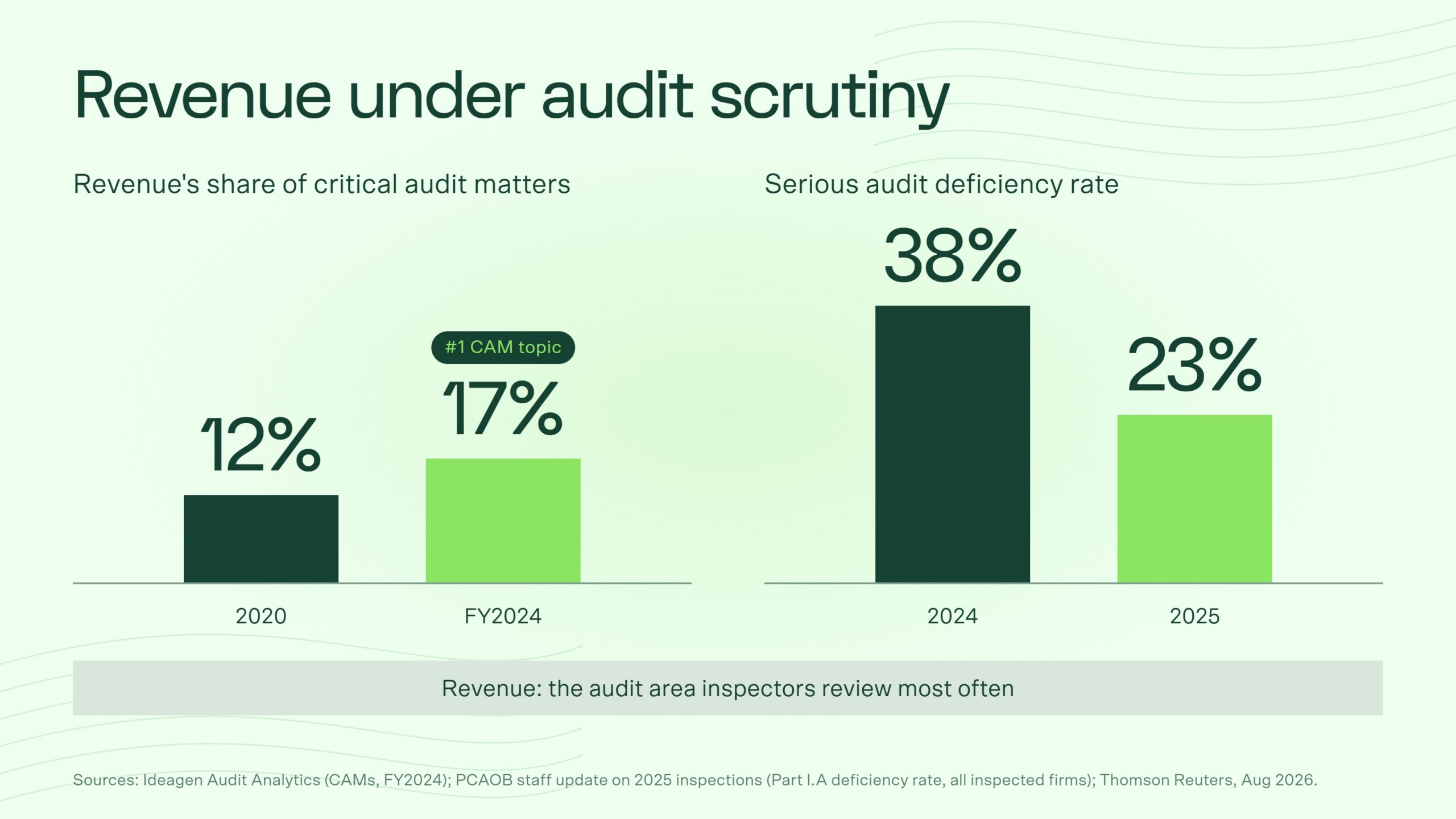
It is also where auditors spend their judgment. Revenue was the most common critical audit matter in U.S. audit reports in fiscal 2024, at 17% of all of them, according to Ideagen Audit Analytics. In the PCAOB’s 2025 inspections, revenue and related accounts were the area inspectors reviewed most often at every one of the six largest audit firms. Auditors are getting better at it, and serious deficiency rates fell sharply last year. They haven’t stopped looking.
Now the uncomfortable part. A revenue number assembled partly in spreadsheets, partly in custom logic written years ago, and partly from billing exports carries more exposure than most finance leaders assume. Most companies at scale work this way. That reflects no failing of the people involved. Revenue teams have kept the number right through years of pricing changes with tools that were never designed for the job.
The fix, though, is contained. It doesn’t require replacing the ERP or the billing system. It requires deciding where the revenue number is derived, making that place governed and traceable, and giving the people who own the number a system that lets them own it.
The market prices doubt, not errors
Doubt about revenue has always been expensive. In February, ICON plc, a profitable global company with more than $8 billion in annual revenue, disclosed that an internal review had found its revenue may have been overstated. Its shares lost as much as 50% in a single session. When the review concluded, the restatements came to 0.8% of 2023 revenue and 1.1% of 2024 revenue, and the company pointed to manual adjustments to revenue contracts among the causes.
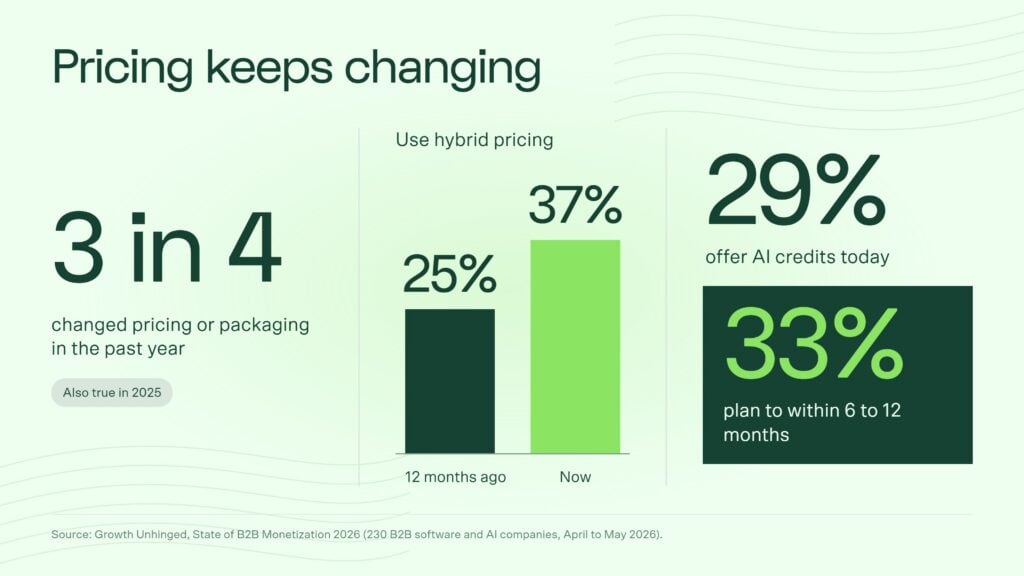
ICON’s case had nothing to do with AI or new pricing models, which is exactly why it is useful. An error of about one percent at a large, established company erased far more than one percent of its value, because for a period nobody could say with confidence what the rest of the number was worth. The market priced the doubt.
The environment companies operate in now produces more of that doubt, and faster.
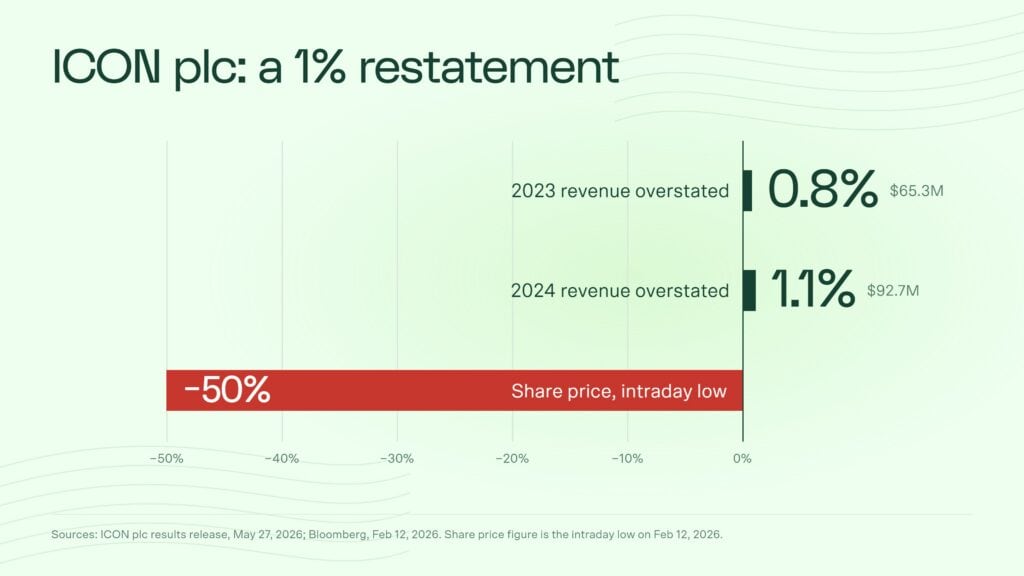
Start with pricing. About three in four software companies changed their pricing or packaging in the past year, for the second year running, and hybrid pricing, a base fee plus usage, became the primary model for 37% of companies, up from 25% a year earlier, according to Growth Unhinged’s 2026 survey. AI accelerates all of it. The price, the packaging and the unit of sale can change inside a single contract term: credits that expire, commitments with overages, model capacity bought at one price and resold at another.
Each of those is a recognition judgment. ASC 606 asks for estimates, allocations and re-measurement that a price list doesn’t contain. Angela Liu, who founded Gaapsavvy, described the structural issue precisely: what a company sells and what it recognizes “get decided by two different teams, and nothing requires them to agree.”
That pressure won’t stay in software. Any industry moving toward subscription, usage and outcome-based pricing will meet the same judgments. Industrial and manufacturing companies are the likeliest next, as equipment shifts to pay-per-use and as-a-service models. Medical technology is close behind; Deloitte found that 80% of 24 leading medtech companies already monetize through subscriptions. Telecom and media, both moving toward outcome-based and as-a-service pricing, will follow.
Capital asks the question early. PwC found that 46% of U.S. companies that went public between 2019 and 2024 disclosed a material weakness in their filings, rising to 54% in technology, media and telecom. For any company planning to raise, list or be acquired, revenue discipline belongs on the readiness list from the first day, because investors will put it there otherwise.
The scrutiny is already here. No new regulatory regime is needed for this to matter; the current one is enough. The PCAOB’s amended evidence standard now requires auditors to evaluate the reliability of information produced or processed by technology, for fiscal years beginning on or after December 15, 2025. Since 2020 the SEC has expected companies to define the operating metrics they publish, explain how they are calculated and use them consistently, and its staff have pressed companies on how ARR differs from GAAP revenue. SEC staff have also asked publicly what allows management and auditors to rely on the data that feeds AI. Whatever brings the next round of scrutiny, it will land on the revenue number first.
AI raises the stakes. Finance teams are deploying agents to forecast, explain variances and answer the board’s questions, and those agents automate against whatever number they are handed. On Vals AI’s Finance Agent benchmark, even the strongest models still miss roughly one in three realistic financial analysis tasks. So the number underneath has to be derived by rule, the same way every time, and traceable to its source. AI built on a number like that multiplies what a finance team can do. AI built on a number nobody can trace multiplies the doubt.
The usage-based billing assumption: covered on the invoice, exposed on the schedule
When pricing changes every few weeks, the urgent question is whether the company can meter it and invoice it. That instinct is reasonable, and billing and metering tools have become very good at answering it.
But billing tells you what you charged. It cannot tell you what you earned.
ASC 606 recognizes revenue based on the contract, and billing records the invoice. A commitment with overages needs an estimate. A credit that may expire raises the question of breakage. A bundle needs its price allocated across everything that was sold. A mid-term change is a contract modification that can reach back into prior periods. None of that appears on an invoice. Deloitte’s guidance is direct about it: the shortcut that lets revenue follow the invoice can’t be applied in all circumstances.
Take a simple case. A customer signs a 12-month contract for 100 seats, with three free months before billing begins. In month two, it adds 50 seats. If recognition follows the invoice, there is nothing to react to, so revenue keeps accruing on 100 seats. In month four the first invoice goes out for 150, and the invoice and the revenue schedule no longer agree. Nothing threw an error, and nobody got an alert.
The market is telling the same story. This year some of the largest payments and CRM companies bought usage-billing engines, and none of the announcements mentioned revenue recognition. Billing is getting much better at charging. That is a real accomplishment, and it is a separate job.
Every pricing experiment that reaches the invoice but not the revenue schedule lands on the controller at close, as a reconciliation done by hand. Multiply that across a market where most companies change pricing every year, and the result is the doubt described above.
Billing and revenue truth work best as two jobs, with clear owners and systems that talk to each other. New pricing should be able to launch without adding accounting risk.
The ERP assumption: it records the number, but who decides it?
The second assumption is just as reasonable. The company already owns a system of record, and every ERP has a revenue module that checks the compliance box.
The ERP records revenue. It was never built to be where revenue gets decided.
An ERP is designed to post balanced entries and report them. Deriving revenue is different work: continuous judgment upstream of the posting, allocating across obligations, re-measuring after every change, estimating variable consideration, and keeping the history of why each number is what it is. When the system of record can’t hold that work, the decision moves somewhere else: a spreadsheet, custom code an integrator wrote, or the billing system. The ERP gets the entry. The reasoning lives outside it, where it is hardest to trace.
That is true of a fifteen-year-old ERP, where the logic is buried in customizations a few people understand and gets rebuilt every time pricing changes. It is just as true of the new generation of ERPs, which handle standard compliance well but still treat revenue as a module inside the ledger. And during an implementation, the program’s attention goes everywhere except revenue, which is exactly when the exposure grows.
Some ERP vendors have begun announcing AI assistants for revenue recognition, which confirms that revenue deserves its own attention. Those assistants work with the data inside their own systems, while the hardest revenue questions, from usage, from outside billing systems and from contract changes, start outside them.
Whatever the stack decision, revenue truth can’t be a secondary workstream inside it.
What defensible revenue makes possible
Everything so far is about risk. The stronger argument for getting this right is what it lets the business do.
Whiteboard to market. When the revenue number is derived by rule and kept current, a new pricing idea can go from the whiteboard to a signed contract to a correct revenue schedule with no gap in between. Finance models the idea, tests it against policy and approves it before sales takes it to a customer. Pricing becomes something the company can experiment with safely.
Creative deals, known consequences. Sales can structure deals with real flexibility, because the accounting effect of every term is known before the contract is signed, rather than discovered at quarter end.
Close on any day. Revenue can be closed on any day of the month. Problems surface the day they occur, with a reason attached, instead of in the last week of the quarter.
Revenue at its smallest unit. The business can see every performance obligation, and every input and change that shaped it. That is what makes analysis trustworthy over time, by product, by customer and by pricing generation. It is also the foundation AI needs to do useful work in finance.
For the CFO, that adds up to four things. Strategy moves faster. Decisions are made with confidence. Capital, whether from investors, lenders, acquirers or public markets, sees a number it can rely on. And the company is ready for the next round of scrutiny instead of reacting to it.
The companies that win the next few years will move quickly and confidently, and they will be able to defend all of it.
Five questions your controller is waiting for you to ask
Any CFO can do this in a week. Sit down with the controller or head of revenue accounting and ask five questions. If the honest answer to any of them is “I’m not sure,” that is the answer.
- Connect to every source. Is our revenue number derived from all of its sources, including contracts, billing, usage and the ERP, and checked before anything is calculated? A good answer names each source, explains how it is checked, and shows what happens when two sources disagree.
- Fit the CFO stack. Does the way we derive revenue work alongside our ERP and billing system, without a re-implementation? A good answer: entries post to the ERP we already run, and billing keeps doing its job.
- Continuous revenue close. Could we close revenue today and explain every variance? A good answer is yes, with the reason for each variance attached, today rather than at quarter end.
- Keep pace with pricing. Can a new pricing model go live without adding accounting risk? A good answer: finance models the new terms and approves the rule before the first contract is signed.
- Audit every change. Can we trace every performance obligation, and every input and change behind it, to its source and the rule that was applied? A good answer opens a contract that changed mid-term and walks from its terms to each schedule line and entry, with the prior version kept.
Then ask four operating questions:
- How are we doing it today, step by step?
- Who owns the revenue number, and do they have the tools to own it?
- What in our stack actually derives the number, and what only records it or moves it?
- What will we improve in the next two quarters, and how will we know it worked?
For controllers, these questions are an opening. They already know where the number is fragile, and this gives them the evidence to raise the priority.
For CFOs, the work is to resist letting the status quo absorb it. Bring in the revenue experts, who know exactly where the risk sits, and give them a system built for the work.
Settle it before it’s settled for you
The market will keep inventing new ways to describe revenue. Run rates, annualized figures and new versions of ARR will come and go with each cycle. The number that matters is the one a company can defend, obligation by obligation and change by change, to an auditor, an investor or its own board, on any day it is asked.
Every company can settle where that number gets derived while it is still its own decision. Otherwise it gets settled for them, by an auditor, an investor or a headline.
The companies that move fastest in the AI economy will be the ones whose revenue number can withstand any question asked of it.
Frequently Asked Questions
What makes revenue defensible?
Revenue is defensible when the company can explain it, obligation by obligation and change by change, on any day it is asked. That takes a number derived by rule, the same way every time, and traceable to its source, so an auditor, an investor or a board can follow any figure back to the contract and the rule behind it.
What is the difference between a revenue recognition module in an ERP and a dedicated revenue recognition platform?
ERP revenue modules are add-ons built within the ERP’s data model, often constrained by its transaction structure. Dedicated revenue recognition platforms are purpose-built to handle the full complexity of ASC 606, including contract management, SSP allocation, modification accounting, and sub-ledger reporting, with deeper flexibility and auditability than ERP modules can typically provide.
What does it mean to derive a revenue number?
Most finance systems store the revenue number, move it or report on it after it is booked. Deriving it means calculating the number from the contract and recalculating whenever something changes, before anything reaches the ledger. The ledger is where the number ends up. The derivation is what makes it right.