
When AI customer-service vendors started charging per resolved ticket, the market reached for a new label: outcome-based pricing. Board decks picked it up. Product teams built it into their pitch narratives. And now controllers and revenue accounting leaders are fielding questions about how to operationalize it.
In June 2026, Deloitte published a Technology Spotlight examining accounting considerations for outcome-based pricing in agentic AI SaaS products under ASC 606, a signal that this has moved from pricing curiosity to a live topic in the accounting community. (Deloitte, “Accounting for Outcome-Based Pricing in an Agentic AI Software Product,” June 2026)
The commercial promise is straightforward: customers pay only when the AI delivers a specified result. But translating that promise into accurate, defensible revenue recognition requires finance teams to solve operational and technical challenges that most billing systems were never designed to handle. This article addresses what needs to be in place before outcome-based pricing can work from a revenue accounting perspective and why the right tool stack matters more than most teams realize.
The Operational Reality Behind Outcome-Based Pricing
The commercial pattern is clear: the customer pays only when the AI delivers a specified result. In AI customer service, that result is typically a resolved support interaction. No resolution, no charge. The billed unit has shifted from a seat or a generic usage metric to a discrete outcome.
For finance teams, the challenge is not the pricing model itself. The challenge is building the operational infrastructure to recognize revenue accurately when every transaction depends on a specific, identifiable event occurring and being able to prove it.
This is where the gap between commercial intent and accounting reality becomes visible. Outcome-based pricing introduces a recognition trigger that most SaaS finance teams have not had to manage at scale: revenue that depends on discrete events rather than time-based subscriptions or metered consumption. That shift changes what the revenue accounting function needs from its systems, its data, and its controls.
What Makes an Outcome Definable for Revenue Recognition Purposes
Under ASC 606, performance obligations can be satisfied either over time or at a point in time. When satisfaction occurs at a point in time, the question is what event marks that point. For outcome-based pricing to work operationally, the trigger needs to meet specific criteria.
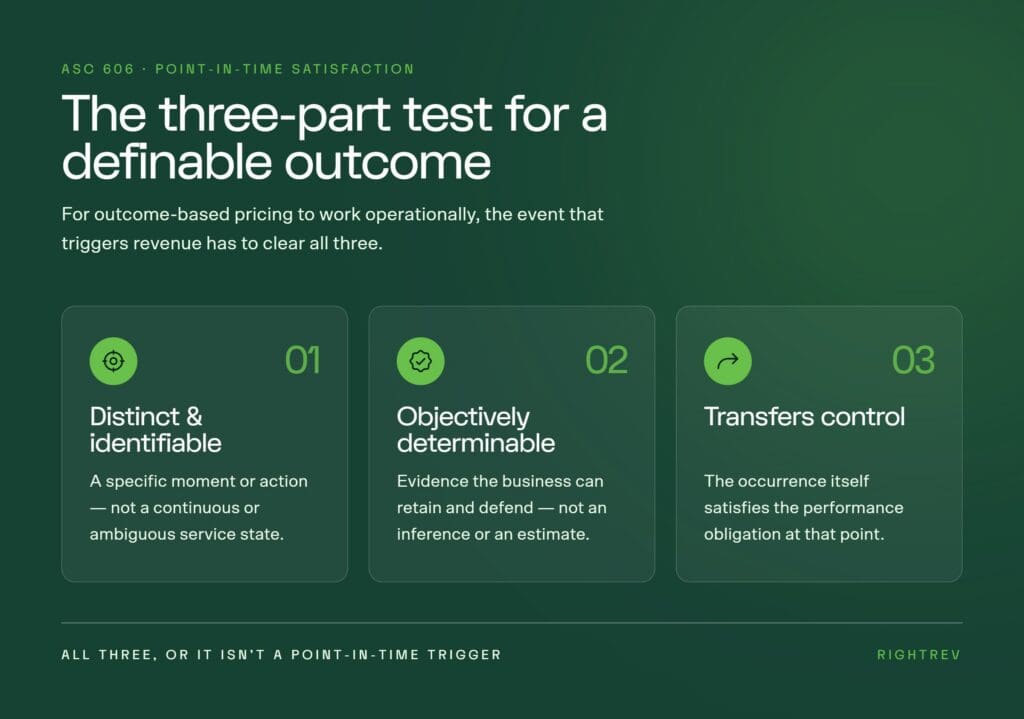
- First, the occurrence must be distinct and identifiable: a specific moment or action, rather than a continuous or ambiguous service state.
- Second, it must be objectively determinable whether the event happened. The business needs evidence it can retain and defend, not an inference or an estimate.
- Third, the event’s occurrence must be what transfers control of the promised good or service to the customer, satisfying the performance obligation at that point.
This is the operational test finance teams need to apply when evaluating whether their systems can support outcome-based pricing. A resolved support ticket, when defined precisely and evidenced clearly, can meet that test. But getting there requires more than a pricing decision. It requires a documented definition of what counts as resolution, a system that captures evidence of that event, and controls that ensure the definition is applied consistently.
How Intercom and Zendesk Defined the Event and What That Reveals
Two public examples ground this pattern in the current AI customer-service market. Neither is presented here as a case study or endorsement. Both are useful because they illustrate the core operational question every outcome-based model has to answer: what, precisely, counts as the event, and how do you know it happened?
Intercom’s Fin AI agent launched with per-resolution pricing at $0.99 per resolved conversation. Under Intercom’s model, a resolution is counted when the customer confirms the issue was solved, or does not request further help after Fin’s final response. The second condition is where the definition gets operationally interesting. A customer who stops replying is not obviously the same thing as a customer who confirms their issue is resolved. The pricing model treats them equivalently. Whether the accounting treatment should do the same is a question the finance team has to answer, and it starts with how the contract defines the event.
Zendesk launched outcome-based pricing for AI agents in August 2024, billing per automated resolution once a customer’s included monthly allocation is exceeded. In May 2026, Zendesk announced that every billed resolution is now verified by both the AI agent and a separate AI evaluation model, with spam and routine exchanges excluded. That update was a direct response to customer disputes over ambiguous resolution counting. The secondary verification layer is, in accounting terms, an attempt to tighten the event definition and the evidence trail behind it.
Both examples show the same thing: once pricing depends on a single event, the business needs a defensible definition of that event and a reliable way to confirm it occurred. That is an operational and contractual question, and it has to be solved before the revenue recognition logic can be implemented. The goal is to implement logic that is auditable and defensible, able to hold up when a customer disputes a bill or an auditor asks how the event was verified.
The Practical Questions Controllers Need to Answer
When a controller encounters outcome-based pricing in a board conversation or a new product pricing proposal, the first move is to translate the commercial language into operational requirements. That means asking a specific set of questions about the event itself.
What precisely counts as the event under the contract or pricing policy? The answer should come from the contract terms, not from product marketing materials. If the contract is silent or ambiguous on the definition of resolution, that is a gap that needs to be addressed before recognition treatment can be documented.
How does the business determine that the event occurred? This is the evidence question. The system needs to capture a timestamp and a decision rule, backed by a record that can be produced in an audit. Customer silence treated as resolution is harder to evidence than an explicit confirmation. The operational controls behind the event definition matter as much as the definition itself.
Does the event mark satisfaction of the performance obligation at a point in time? This is the ASC 606 step 5 question. If the answer is yes, the recognition pattern follows the event. If the answer is less clear, because the service is ongoing or the event is ambiguous, the classification may need to be revisited.
The wrinkle that both Intercom and Zendesk have encountered publicly is not a novel accounting problem. It is the familiar challenge of defining and evidencing a recognition trigger precisely enough to support the treatment. Finance teams that address the event definition early, before the pricing model is in production, are in a better position than those who inherit an ambiguous definition and have to work backward from disputed invoices.
Why Billing Systems Alone Can’t Handle Event-Based Recognition
Most billing systems are optimized for invoicing and collections, not for revenue recognition. They track what was billed and when, but they do not inherently track whether a performance obligation was satisfied, how revenue should be allocated across multiple elements, or how to handle contract modifications that affect prior periods.
When a company adopts outcome-based pricing, the billing system captures the event that triggered the charge. But translating that event into compliant revenue recognition requires additional logic that sits outside the billing layer:
- Determining whether the event satisfies a performance obligation at a point in time
- Allocating transaction price when multiple performance obligations exist
- Handling deferred revenue when payment precedes the event
- Managing contract modifications that change the event definition or pricing
- Maintaining an audit trail that connects the event to the recognized revenue
Not all billing systems were designed to solve these problems, they were designed to generate invoices. Revenue recognition requires a separate layer that reads event data from billing, applies ASC 606 logic, and outputs compliant revenue schedules and journal entries.
How a Revenue Recognition Tool Should Support Outcome-Based Pricing
For outcome-based pricing to work operationally, finance teams need a tool that can:
- Ingest event data from multiple sources: The recognition engine needs to read event data wherever it originates: billing systems, CRM, usage tracking platforms, data warehouses, or custom applications.
- Apply event-based recognition logic consistently: The system needs to recognize revenue when the event occurs, not when the invoice is generated. That requires treating the event as a first-class recognition trigger, independent of billing timing.
- Handle contract modifications and reallocations: When contract terms change, the system needs to recalculate revenue schedules, apply catch-up adjustments, and maintain a clear audit trail of what changed and why.
- Maintain deferred revenue balances accurately: When payment precedes the event, the system needs to track deferred revenue and recognize it only when the event occurs. This requires coordination between billing data and event data.
- Provide audit-ready traceability: Every recognized revenue amount needs to be traceable back to the source event, the contract terms, and the accounting policy that governed the treatment. The system needs to produce that trail on demand.
Outcome-based, per-resolution pricing is variable consideration under ASC 606. The total transaction price is not known at contract inception because it depends on how many resolution events occur. Estimating and constraining variable consideration is a distinct accounting step that sits upstream of recognition execution. RightRev executes recognition logic and produces the audit trail once the transaction price is determined. It does not estimate or constrain variable consideration.
A purpose-built revenue recognition platform like RightRev sits downstream of event data, wherever it originates. It reads event triggers from billing systems, applies ASC 606 logic, and outputs compliant revenue schedules without requiring finance teams to rebuild their billing infrastructure. As new event types emerge, whether from AI pricing models, usage-based billing, or hybrid arrangements, the recognition treatment follows the accounting analysis rather than the billing system’s native capabilities.
Accounting Requirements for Adopting Outcome-Based Pricing
Adopting outcome-based pricing does not just change how customers are billed. It changes what the finance team is responsible for maintaining:
- A documented definition of what counts as an outcome
- Evidence that the outcome occurred for every billed transaction
- Controls that ensure the definition is applied consistently
- A revenue recognition process that handles event-based triggers at scale
- An audit trail that connects events to recognized revenue
These are not one-time setup tasks. They are ongoing operational requirements that compound as transaction volume grows. Finance teams that treat outcome-based pricing as a billing decision, rather than a revenue accounting project, typically discover the operational burden during the first close cycle or audit.
The teams that operationalize outcome-based pricing successfully are the ones that address the revenue accounting requirements before the pricing model goes live. That means defining the event clearly, building the evidence trail, and ensuring the tool stack can handle event-based recognition at scale.
Getting Ahead of the Audit Question
The accounting community has started paying attention to outcome-based AI pricing. Deloitte’s June 2026 Technology Spotlight is one signal. The public disputes over resolution counting at major AI customer-service vendors are another. Finance teams that are still treating this as a future problem are likely to find it arriving faster than expected.
Controllers who establish the event definition now, document the recognition logic, and build the evidence trail behind it are doing the work that will matter when auditors ask the same questions.
For a deeper look at how AI pricing models interact with ASC 606 recognition requirements, check out our AI Revenue Recognition blog, as it covers the broader AI landscape. For teams working through usage-based and consumption models alongside outcome-based arrangements, the usage-based revenue recognition blog addresses the recognition patterns that apply across variable pricing structures.
If outcome-based or hybrid pricing is on your roadmap, the questions in this article are worth answering before the model goes live, not after the first disputed invoice. Request a demo and walk through how RightRev handles event-triggered recognition against your own contract structures, or start with the Revenue Complexity Assessment, an 11-question diagnostic that maps your pricing models against what a production recognition system needs to handle.
Frequently Asked Questions
What is consumption-based pricing and how is it different from subscription pricing?
Consumption-based pricing charges customers based on actual usage of a product or service, such as API calls, compute hours, or data volume. Subscription pricing charges a fixed recurring fee for access regardless of usage. From a revenue recognition standpoint, consumption models require variable consideration treatment, whereas subscriptions are typically recognized ratably.
What is the difference between a revenue recognition module in an ERP and a dedicated revenue recognition platform?
ERP revenue modules are add-ons built within the ERP’s data model, often constrained by its transaction structure. Dedicated revenue recognition platforms are purpose-built to handle the full complexity of ASC 606, including contract management, SSP allocation, modification accounting, and sub-ledger reporting, with deeper flexibility and auditability than ERP modules can typically provide.