Revenue Recognition for SaaS Companies: How to Scale Without Breaking Your Close Process
Revenue recognition for SaaS companies is the process of recognizing subscription, services, and/or usage-based revenue under ASC 606 as performance obligations are satisfied over time, not when cash is collected or invoices are issued. At scale, the process typically breaks at four predictable points: standalone selling price (SSP) allocation across multi-element arrangements, contract modifications that require systematic recalculation, variable consideration handling for usage-based pricing, and audit support reconstruction across disconnected spreadsheets.
The close that used to take five days starts running two to three weeks. A finance team managing revenue schedules across a growing stack of spreadsheets, billing exports, and manual journal entries, each one a workaround that made sense at the time and now represents a control risk.
For high-growth SaaS and software companies, this is not an unusual story. It is a predictable one. Between Series B and Series C, when contract volume is climbing, enterprise deals are getting more complex, and usage-based pricing has moved from a pilot to a meaningful portion of ARR, the processes that worked at $5M ARR begin to visibly strain at $30M. ASC 606 did not create that operational complexity. But it made it significantly harder to manage informally.
This article is not an ASC 606 explainer. If you are a VP Finance or Controller at a scaling SaaS company, you already know the five-step model. What this article addresses is the operational experience of outgrowing a manual revenue recognition process, what the signals look like, why the architecture breaks, and what companies at this stage typically do about it.
What Makes Revenue Recognition for SaaS Companies Structurally Different Under ASC 606
Most industries recognize revenue when a product ships or a service is delivered in a discrete event. SaaS does not work that way, and that distinction has compounding consequences at scale.
The five-step ASC 606 model applies the same way it does to any industry:
- Identify the contract with the customer.
- Identify the performance obligations in the contract (the distinct promises to deliver goods or services).
- Determine the transaction price (the total amount of consideration expected).
- Allocate the transaction price to each performance obligation based on standalone selling price (SSP).
- Recognize revenue as each performance obligation is satisfied.
The complexity for SaaS shows up at step 2 (most contracts have multiple obligations), step 4 (SSPs change as products and pricing evolve), and step 5 (obligations are satisfied over time, not at a point in time).
Revenue Is Recognized as Service Is Delivered, Not When Cash Is Collected or Invoices Are Issued
The revenue event in SaaS is the satisfaction of performance obligations over time, not the billing event. A $120,000 annual subscription billed upfront in January does not generate $120,000 in recognized revenue in January. It generates approximately $10,000 per month as the service is delivered, while the remaining cash sits in deferred revenue on the balance sheet.
That distinction is manageable when you have 30 active contracts and a simple monthly subscription model. It becomes a system problem when every active contract needs an accurate, rolling revenue schedule that updates when contracts change, when billing terms shift, or when customers add or remove services mid-term.
SaaS Contracts Often Include Multiple Performance Obligations That Require SSP-Based Allocation
Revenue recognition for software companies becomes meaningfully more complex when a single deal includes subscription access, implementation services, premium support, training, or data add-ons. Under ASC 606, each distinct promise in a contract is a separate performance obligation, and the transaction price must be allocated across those obligations in proportion to their standalone selling prices, not based on how the deal was negotiated or how the invoice was structured.
This is one of the most common failure points in manual environments. Discounts applied at the deal level need to be spread proportionally across obligations. SSP assumptions need to be documented, defensible, and consistently applied. And when a contract is modified, the allocation may need to be revisited. None of that logic is straightforward to maintain in a spreadsheet, and it becomes increasingly difficult to audit as contract volume grows.
Usage-Based Pricing Creates Two Different Accounting Challenges Under ASC 606
SaaS revenue recognition under ASC 606 gets more complex when contracts include overages, consumption tiers, seat expansions, or other usage-based components, but the accounting treatment depends on the contract structure, not just the presence of usage.
Pure pay-as-you-go consumption contracts typically don’t trigger variable consideration. The customer pays for what they consume. The accounting challenge is timing: usage occurs throughout the period but metering data closes days after billing. Finance teams accrue revenue for usage that has occurred but not yet been invoiced. The mechanism is revenue accrual against actual usage, not estimation.
Commitment contracts with overage pricing are where variable consideration applies. When a customer commits to a baseline (1M API calls per month, 500 seats, a minimum spend) with usage-based charges on anything above it, ASC 606 requires the company to estimate the expected overages based on usage trends, apply the constraint (recognizing only the amount for which it is highly probable a significant reversal will not occur), and recognize that estimated variable consideration over the life of the contract rather than when the overages are eventually billed.
Both treatments are data challenges, not just accounting challenges. Metering data lives in the product or billing system, not the ERP. It often closes days after the accounting period ends. Most ERPs cannot apply variable consideration constraint logic natively, and they cannot ingest and normalize usage data at the contract level for accrual purposes either.
The scale of this issue is worth noting: approximately 61% of SaaS companies now offer some form of usage-based pricing. Whether the correct treatment is revenue accrual or variable consideration estimation depends on contract structure, but both require contract-level integration with usage data that sits outside the ERP.
When Has Your Revenue Recognition Process Stopped Scaling?
The inflection point is rarely a single event. It is a cluster of operational signals that appear gradually and then, suddenly, all at once. Finance leaders who have been through this tend to recognize the same set of symptoms. The five most reliable signals, in order of how clearly they indicate the architecture has reached its limit:
- Close cycle has stretched from days to two or three weeks, with revenue consistently the last major area to finish.
- SSP allocation is still being handled manually each period via spreadsheets, hardcoded price tables, or analyst-maintained workbooks.
- Contract modifications are being treated as one-off reconciliations rather than systematic accounting events.
- Usage-based revenue is forcing close delays or hard-to-defend estimates because metering data closes after accounting needs it.
- Audit support requires reconstructing revenue logic from spreadsheets rather than producing it as a continuous system output.
If two or more of these are familiar, the architecture has typically reached its structural limit.
1. The Close Stretches from Days to Two or Three Weeks
What used to be a manageable five-day close starts to expand as the team downloads billing files, updates revenue schedules, posts journal entries, and reconciles deferred revenue balances, manually, for every active contract. Each step takes longer as contract volume grows, because the process scales with headcount, not with automation.
The issue is usually not one large breakdown. It is the accumulation of small manual steps that no longer fit inside the close calendar. If revenue is consistently the last major area to finish each month, and the team is regularly working into the third week to get there, that is typically a sign the current process has reached its structural limit.
2. SSP Allocation Is Still Being Handled Manually Each Period
Manual SSP allocation often relies on spreadsheet logic, VLOOKUP-style formulas, hardcoded price tables, analyst-maintained workbooks, that is difficult to audit, difficult to update when pricing changes, and easy to break when product packaging evolves.
Common errors in this environment include applying the residual method when conditions do not support it, using SSP estimates that have not been updated to reflect current pricing, and allocating discounts at the deal level instead of proportionally across performance obligations. Each of these is an audit exposure. At 50 contracts, the risk is manageable. At 300 or more active contracts with frequent modifications, it becomes a material control concern.
3. Contract Modifications Are Treated as One-Off Reconciliations Instead of Systematic Events
Mid-term upgrades, downgrades, add-ons, renewals, and renegotiations are routine in enterprise SaaS. They are also not all treated the same way under ASC 606. Depending on the facts and circumstances, a modification may be accounted for as a separate contract, a prospective modification of the original arrangement, or a cumulative catch-up adjustment in the period of change.
When finance teams manage this through ad hoc journal entries rather than systematic recalculation, timing mismatches and inconsistent treatment become much more likely. A modification logged in the billing system on the 15th of the month may not be reflected in the revenue schedule until the close, or until someone notices the discrepancy. At audit, this is exactly the kind of pattern that raises questions about the reliability of controls.
4. Usage-Based Revenue Is Delaying the Close or Forcing Estimates Without Strong Support
Metering data often closes after accounting needs it. That leaves finance teams with a choice: delay the close to wait for complete usage figures, or recognize estimates that may be difficult to defend under the constraint requirement. Neither option is comfortable, and neither scales well as usage-based deals become a larger share of the portfolio.
Most ERPs do not natively ingest, normalize, and link usage data to contract-level revenue schedules. That means the accounting process for usage-based components typically depends on manual data pulls, spreadsheet calculations, and judgment calls that are hard to document consistently. If usage-based deals have become material to the business, the accounting process now has a dependency on operational data flows that sit entirely outside the general ledger.
5. Audit Support Requires Reconstructing Revenue Logic from Spreadsheets
Auditors expect traceable revenue waterfalls: how deferred revenue rolls forward into recognized revenue, by contract, by performance obligation, and by period. They expect to be able to drill into a specific contract and see the full recognition history, including how modifications were treated and how SSP was applied.
When that data lives across analyst workbooks and monthly close files, producing it for audit is a reconstruction project, rather than a reporting exercise. Finance teams in this situation often spend three to five weeks per year rebuilding support that a purpose-built system would preserve continuously as a byproduct of the close. That is time the team does not have, and it is a risk that grows with every additional contract in the portfolio.
CRM, Billing, and ERP No Longer Tell the Same Revenue Story
CRM reflects what was sold. Billing reflects what was invoiced. The ERP reflects what was posted. None of those systems, by themselves, fully resolves ASC 606 logic, and the gaps between them are where errors compound.
A contract for SaaS platform access plus implementation services appears as two line items in the CRM, not as two separate performance obligations with different recognition schedules and different SSP allocations. When billing changes are made mid-term, they may not be reflected in the revenue schedule until someone manually reconciles the systems. If revenue accounting depends on that reconciliation every month, scale will continue to increase the risk surface.
Why Spreadsheets and ERP-Native Tools Break for SaaS Revenue Recognition
Understanding why the process breaks is as important as recognizing that it has. The failure is not usually a matter of effort or attention. It is architectural.
The three architectural options most SaaS finance teams choose between, scored on the four hardest-to-scale dimensions:
| Capability | Spreadsheets | ERP-Native Revenue Module | Purpose-Built Rev Rec Platform |
| Contract modification accounting | Ad hoc journal entries per change | Partial automation, often requires manual review | Systematic recalculation triggered by modification events |
| SSP allocation across multi-element arrangements | Manual, error-prone above ~50 contracts | Better controls, but limited multi-element automation | Automated, policy-enforced at contract inception and modification |
| Variable consideration / usage-based revenue | Manual pulls + spreadsheet math | Generally not supported natively | Native ingestion, constraint logic, automated true-ups |
| Audit trail / revenue waterfall | Reconstructed each audit cycle | Available but limited to transaction view | Continuous, contract-level, performance-obligation-level |
| Scales reliably to | ~$5-10M ARR | ~$30-50M ARR | $50M+ ARR with usage-based pricing |
Spreadsheets Work at Low Complexity, Then Fail Quietly as Volume and Change Increase
Many growth-stage teams begin with Excel or Google Sheets because the contract base is small and the pricing model is simple. Monthly subscriptions, consistent pricing, no usage components, spreadsheets are a reasonable starting point. That approach becomes fragile once the business adds multi-year terms, bundled arrangements, usage charges, and frequent modifications.
A documented pattern in SaaS finance is teams managing revenue across 40 or more spreadsheets around the $20M ARR stage. At that point, the spreadsheet is no longer a tool, it is a liability. Version control becomes a problem. Formula errors propagate silently. And the institutional knowledge of how the model works often lives with one or two people, which is its own operational risk.
ERP Revenue Modules Improve Control, But They Are Still Constrained by Transaction Structure
ERP-native revenue modules are a meaningful step up from spreadsheets. They provide better controls, more structured data, and a closer connection to the general ledger. But they were not designed to systematically apply ASC 606 logic across thousands of changing SaaS contracts.
The core limitation is structural. ERPs are built around transaction processing, not contract-level revenue policy enforcement. They typically struggle with SSP policy application across multi-element arrangements, modification accounting that requires recalculating remaining allocation, and variable consideration logic tied to external metering data. In many environments, the ERP still depends on manual journal entries for the most complex revenue recognition scenarios, which means the control gap has not been closed, it has just been moved.
The Real Issue Is Architectural, Not Just Procedural
Revenue recognition for SaaS companies sits at the intersection of contract data, pricing policy, billing events, usage data, and accounting treatment. When those inputs live in different systems (CRM, billing platform, metering system, ERP), manual reconciliation becomes the control mechanism by default. That architecture does not scale.
This is not a niche problem. According to a 2023 Financial Executives Research Foundation study, 67% of companies reported that ASC 606 required significant changes to their revenue recognition processes. For SaaS companies specifically, those changes are ongoing, because the contracts themselves keep changing.
How Do High-Growth SaaS Companies Scale Revenue Recognition Without Breaking the Close?
The answer is not more headcount. It is a different architecture, one where accounting policy is enforced systematically across contracts, rather than applied manually by analysts each period.
Automate SSP Allocation and Apply Policy Consistently at the Contract Level
A scalable revenue recognition model starts with documented SSP policies and a system that allocates transaction price across performance obligations consistently, at contract inception, and again when qualifying modifications occur. SSP should be locked at contract inception for existing arrangements. When a modification triggers reallocation, the system should apply current-date SSPs to remaining obligations automatically, not through a manual journal entry.
Automation here does not replace accounting judgment. It enforces approved policy at a volume that spreadsheets cannot manage reliably. The finance team still owns the SSP methodology, observable price, expected cost plus margin, or residual where conditions support it. The system executes that methodology consistently across every contract in the portfolio.
Treat Contract Modifications as Structured Accounting Events, Not Manual Exceptions
A workable process at scale evaluates each modification against ASC 606 criteria and applies the correct treatment: separate contract, prospective modification, or cumulative catch-up. That determination should be driven by the facts of the change, not by which approach is easiest to post.
When modification events are logged in the system, the correct accounting treatment should trigger automatically, updating remaining allocation, adjusting revenue schedules, and creating the appropriate journal entries. This is especially important in enterprise SaaS, where add-ons and scope changes are routine rather than exceptional. If every modification requires a manual review and a one-off journal entry, the close will always be at the mercy of modification volume.
Connect Usage Data to Contracts So Variable Consideration Can Be Estimated and Trued Up Systematically
Usage-based revenue requires metering data to be normalized, tied to the contract, and reflected in revenue schedules with appropriate constraint logic applied. Without that connection, finance is forced into manual accruals, close delays, or recognition based on incomplete information, none of which is defensible at audit.
As pricing models shift toward hybrid subscription and consumption structures, this capability becomes operationally important. The accounting team should not be manually pulling usage reports from the product system each month and translating them into revenue entries. That data flow should be systematic, traceable, and connected to the contract record.
Maintain Deferred Revenue Schedules and Audit Trails as a Continuous System Output
Deferred revenue should roll forward automatically as billing events, contract changes, and recognition schedules evolve over time. A purpose-built revenue subledger can preserve revenue waterfalls by contract, by performance obligation, and by period, making audit support easier to produce and easier to defend, because it was never reconstructed in the first place.
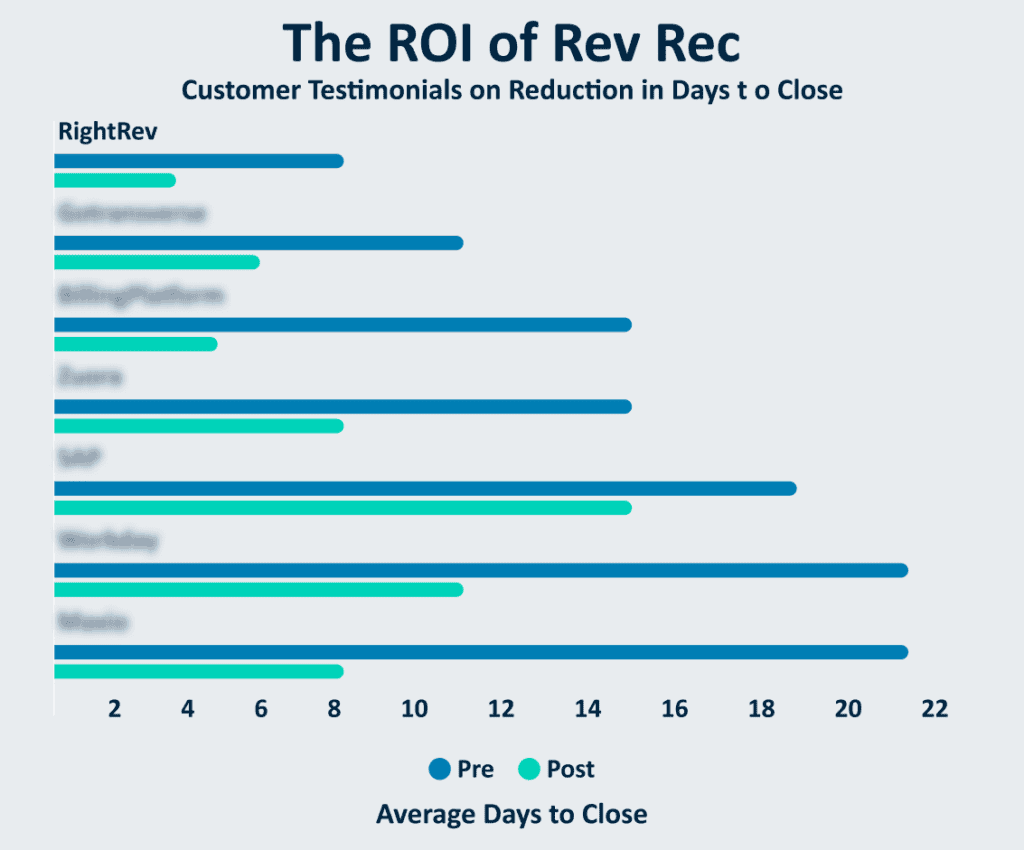
In practice, finance teams that move from manual processes to automated recognition typically see close cycles compress from weeks toward days. The calculations that used to require human bandwidth, running schedules, posting entries, reconciling deferred balances, are handled systematically, which frees the team to focus on review and judgment rather than data processing.
See the full report from MGI Research here.
What Does a Scalable Revenue Recognition Operating Model Look Like for Software and SaaS Companies?
Getting to a scalable model is not just a technology decision. It is an operating model decision.
Finance Owns Policy; Systems Enforce It Across the Order-to-Revenue Process
The strongest operating models separate accounting judgment from repetitive calculation. Finance owns the policy: SSP methodology, modification treatment criteria, variable consideration thresholds, review controls. The system executes that policy consistently across every contract, every period, without requiring an analyst to manually apply it each time.
That separation requires the revenue engine to sit close enough to CRM, billing, ERP, and product data to reflect commercial reality accurately. A contract modification logged in the CRM should flow through to the revenue schedule without a manual handoff. A usage event recorded in the metering system should inform the recognition calculation without a manual data pull. When those connections are systematic, the close becomes a review process rather than a data assembly process.
The Right Trigger for Change Is Usually Operational Pain, Not Just Audit Pressure
Most teams do not replace their revenue recognition process because ASC 606 is new. They do it because the existing process is starting to impair the close, complicate the audit, or slow down decision-making. The inflection point is operational before it is regulatory.
Typical triggers include increasing enterprise deal complexity, more frequent pricing changes, the introduction of usage-based products, and a finance team that is adding manual workarounds every quarter to keep up. If the team is spending more time on revenue mechanics than on revenue analysis, that is usually a clearer signal than any single compliance event.
“My team is spending too much time entering basic transaction data. This should be automated so that my team can focus on what we do best: revenue analysis. We need to focus our efforts on the highest-risk areas rather than data entry.”- Controller, $500M Revenue SaaS company
What Finance Leaders Should Evaluate Before Making a Change
Before evaluating platforms, it is worth being honest about where the current process actually stands. Can it systematically handle SSP allocation across multi-element arrangements? Does it apply the correct modification treatment based on ASC 606 criteria, or does it rely on analyst judgment and ad hoc entries? Can it ingest and normalize usage data at the contract level? Does it produce deferred revenue rollforwards and revenue waterfalls continuously, or only when audit season requires it?
Look for the gaps between systems, specifically where CRM, billing, metering, and ERP data require manual interpretation before a revenue outcome can be reached. Those gaps are where errors accumulate and where the close gets extended.
If two or more of the signals described in this article are familiar, it is usually worth evaluating whether a purpose-built revenue recognition platform would reduce risk and compress the close. Because the architecture that works at $5M ARR is not the architecture that will work at $50M, and the cost of staying manual compounds with every new contract, every modification, and every audit cycle.
When Should a SaaS Finance Team Replace Their Revenue Recognition Process?
Revenue recognition for SaaS companies breaks first as an operational process, then as a control issue. The hardest areas to scale manually are SSP allocation, contract modifications, variable consideration, and deferred revenue schedules, precisely because they require consistent policy application across a high volume of changing contracts, connected to data that lives outside the general ledger.
The challenge is not understanding ASC 606 in theory. Finance leaders at scaling SaaS companies understand the standard. The challenge is applying that logic accurately, consistently, and fast enough to support a business that is growing faster than the process can keep up with.
A scalable close depends on systems that can enforce accounting policy systematically, across thousands of contracts, across modification events, across usage data feeds, without requiring human bandwidth to execute each calculation. That is an architectural answer to an architectural problem.
If the signals in this article describe your current close, it is worth having a conversation about what a purpose-built revenue recognition platform would change. Schedule a demo with RightRev to see how companies at your stage have compressed the close, strengthened audit readiness, and built a revenue recognition process that scales with the business, not against it.
Frequently Asked Questions
How does revenue recognition work for SaaS subscription contracts?
For SaaS subscriptions, revenue is typically recognized ratably over the subscription period as the service is delivered, since the customer simultaneously receives and consumes the benefit. Upfront fees, implementation services, and add-ons may require separate treatment depending on whether they are distinct performance obligations.
What are the most common SaaS accounting compliance challenges under ASC 606?
Common challenges include correctly identifying and separating performance obligations in bundled deals, determining and documenting standalone selling prices, handling contract modifications from upgrades and downgrades, accounting for variable consideration from usage tiers, and managing the volume of contracts at scale without automation.
How does revenue recognition automation reduce close cycle time?
Automation eliminates the manual steps of pulling contract data, building recognition schedules, manually calculating allocations, and reconciling sub-ledgers. By processing contracts in real time and maintaining a continuously updated revenue position, automated systems can compress close from days to hours, giving finance teams more time for analysis and review.