
A comprehensive look at how Snowflake transformed their consumption-based revenue management from manual processes to industrial-scale automation
The Challenge of Usage-Based Revenue
When companies transition from traditional subscription models to consumption-based pricing, they face a fundamental shift in how they manage revenue recognition. This isn’t just about adjusting a few formulas, it’s about completely rethinking the infrastructure that supports financial operations.
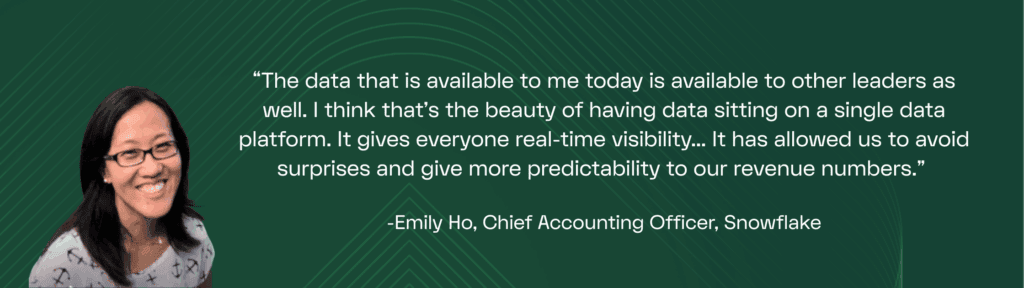
Emily Ho, Chief Accounting Officer at Snowflake, and Jagan Reddy, a pioneer in automated revenue management and founder of RightRev, recently shared insights from Snowflake’s journey in scaling their revenue recognition to handle massive volumes of usage-based transactions.
Understanding Snowflake’s Complexity
Snowflake operates on a consumption-based model where customers purchase credits at specified discount rates over certain durations. These credits can be used across various platform features including:
- Compute and storage resources
- Data transfer operations
- AI features like Cortex AI
- Marketplace applications and data from third-party vendors
This flexibility creates tremendous value for customers but introduces significant complexity on the backend. As Ho explains, “This flexibility is great from a customer-first perspective, but it also requires a pretty robust engine and infrastructure on the back end to allow us to recognize revenue in accordance with ASC 606.”
The Scale Challenge
The numbers behind Snowflake’s operation are staggering. The company processes more than a million usage events, and unlike traditional month-end processing, this happens continuously, every single day. This volume requires what Reddy describes as “continuous revenue recognition,” providing up-to-date revenue information that helps with forecasting and business decision-making.
Key Misconceptions About Usage-Based Revenue
One of the biggest mistakes companies make, according to Reddy, is trying to apply subscription-based systems and processes to usage-based models. “Subscriptions are time-based entitlements, and usage is completely event-based entitlement, so it’s completely different,” he explains.
Usage-based models require:
- Continuous measurement and metering
- Variable timing and amounts
- Real-time data processing
- Complex allocation across multiple performance obligations
Evolution from Spreadsheets to Automation
Snowflake’s journey began with attempting to make their ERP system work for their complex revenue model. When that proved insufficient, they relied heavily on manual spreadsheets, a common but unsustainable approach for companies at scale.
The transformation to automated revenue management eliminated much of this manual work. While some spreadsheets remain, Ho notes they represent “a lot fewer than what it would have been if we didn’t have the right infrastructure in place.”
Build vs. Buy Decision
Despite being a robust software company with strong engineering capabilities, Snowflake chose to partner with an external solution for revenue recognition. Ho explains their reasoning:
“We came to realize that it is a very large level of effort and investment on in-house engineering talent that could be deployed to product innovation and delivering new features, and really kind of differentiating our core product.”
Understanding revenue recognition and ASC 606 compliance wasn’t a core competency of their engineering team, making the purchase decision strategically sound.
The Data Quality Imperative
Both experts emphasized that data quality is the foundation of successful automated revenue management. The challenges include:
Continuous Data Cleansing
Unlike traditional month-end processes, usage-based models require daily data validation and cleaning. As Reddy explains, “If you let it slide through, then you’re stuck at month-end where you’re going and doing all this cleaning, which is going to really slip your close timeline.”
Linking Usage to Contracts
Properly connecting usage data to contract terms is critical for determining whether consumption falls within committed amounts or represents overage billing. This directly impacts variable consideration calculations and revenue recognition timing.
Source System Accuracy
A crucial principle: always fix data issues in the source system, not in the revenue system. This maintains consistency across all downstream processes and reduces reconciliation complexity.
AI and the Future of Revenue Management
While AI shows promise for revenue management, both speakers emphasize the need for precision. “Revenue recognition has to be 100% correct, there’s nothing in between like you can get 70% accuracy or 80% accuracy,” Reddy states.
Current AI applications focus on operational efficiency rather than core calculations. However, one promising area is revenue forecasting, where AI can analyze historical usage patterns, seasonality, and contract terms to predict future revenue in consumption-based models.
Business Impact and Outcomes
The automation of revenue management has delivered significant business value for Snowflake:
✔️ Accelerated Financial Close
Real-time revenue visibility allows for faster month-end closes, critical for a public company where revenue is a key metric.
✔️ Improved Predictability
Unlike subscription companies that can close books on day one of a quarter, usage-based companies face uncertainty. Automated systems help provide better forecasting and reduce quarter-end surprises.
✔️ Business Agility
The foundation supports rapid experimentation with new pricing models, particularly important as Snowflake launches AI features and explores different discount strategies.
Lessons Learned
Start Early
Ho recommends implementing automated revenue management earlier rather than later: “It’s easier to move to a different software when there is less data to deal with.”
Embrace Change Management
Moving from month-end to daily processing represents a significant mindset shift for finance teams. Organizations must prepare for this cultural transformation.
Plan for Evolution
Product introductions and pricing changes are constant. Over four years, Snowflake has continuously evolved their offerings, and their automated system has enabled rapid adaptation to these changes.
Data Readiness is Ongoing
Initial implementation is just the beginning. Companies must budget for continuous data quality improvements and system maintenance.
Key Takeaways for Other Companies
- Don’t underestimate data complexity: Usage-based revenue requires fundamentally different data management approaches than subscription models.
- Change management is critical: The shift from month-end to continuous processing requires significant organizational adaptation.
- Consider the total cost of building: Engineering resources might be better deployed on core product differentiation rather than revenue management infrastructure.
- Plan for scale: What works at smaller volumes may not scale to industrial-level transaction processing.
- Future-proof your investment: Choose solutions that can adapt to evolving business models and pricing strategies.
The Bottom Line
Snowflake’s journey demonstrates that while consumption-based pricing creates tremendous customer value, it requires sophisticated backend infrastructure to manage effectively. The combination of robust data management, automated processing, and continuous monitoring has enabled Snowflake to scale their operations while maintaining accuracy and compliance.
As more companies move toward usage-based models, particularly with the rise of AI services, the lessons from Snowflake’s experience provide a valuable roadmap for managing the complexity of modern revenue recognition at scale.
For companies considering similar transformations, the key is recognizing that this isn’t just a technology challenge, it’s a fundamental reimagining of how revenue operations work in a consumption-driven world.
Watch the full webinar recording here: “Revenue Masters: How Snowflake Scales Revenue Recognition in the Consumption Economy”