
Session Recap: Measuring AI ROI From Quote to Revenue at Dreamforce 2026
This session explores why AI spend has moved from an adoption question to a return question, how connected quote-to-cash and revenue accounting data determines whether AI can be trusted, and where human judgment still belongs in finance workflows.
What This Session Covers:
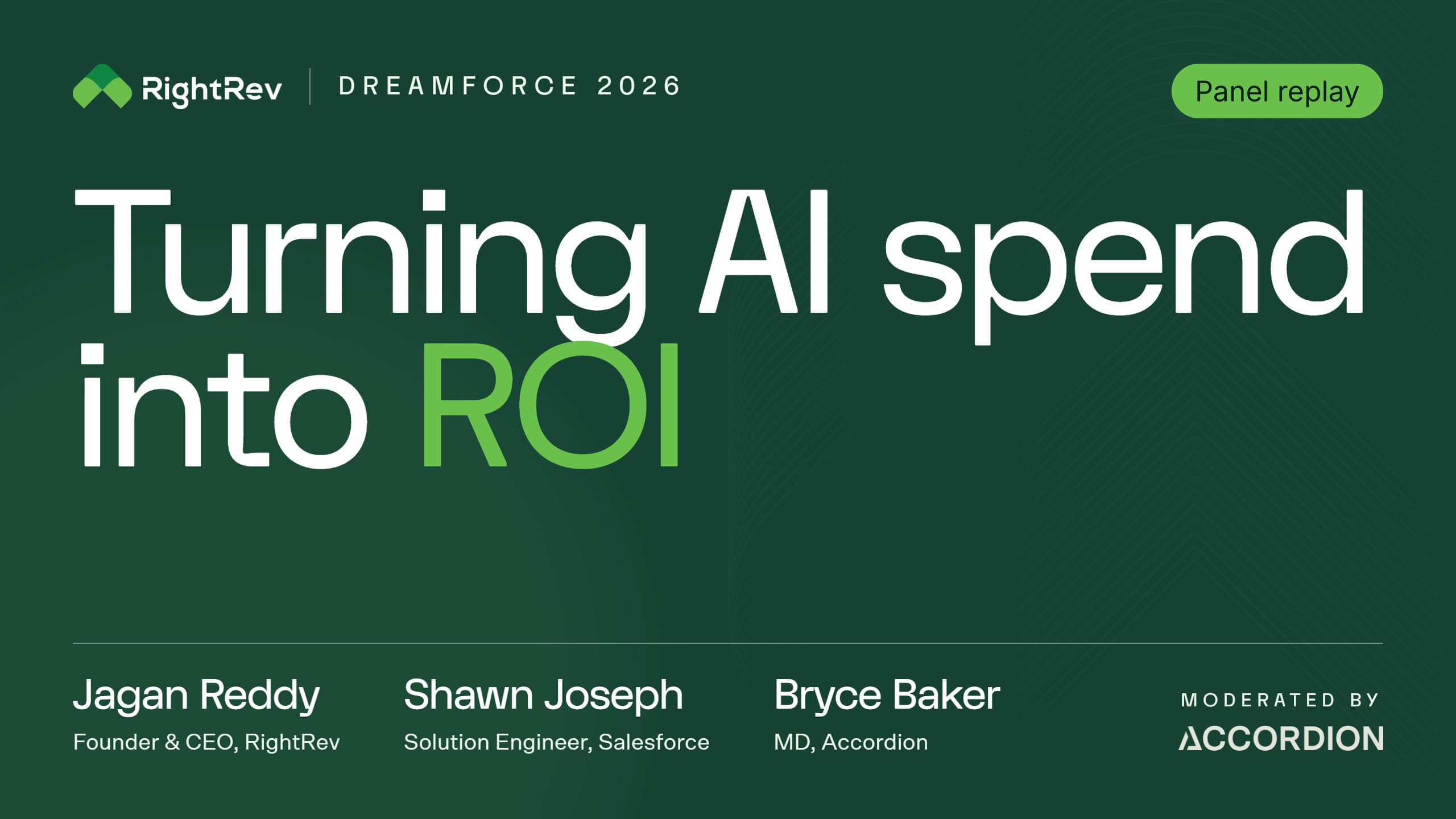
At Dreamforce 2026, RightRev founder and CEO Jagan Reddy joined Shawn Joseph, a billing-focused solution engineer on Salesforce’s Revenue Cloud team, and Bryce Baker, managing director and co-lead of the lead-to-cash practice at Accordion, to discuss how finance teams get a return on AI spend.
A central theme is the shift from AI adoption to AI return. A year ago the push was usage, with token maxing and leaderboards. Today private equity-backed companies want to see savings and growth. Shawn said AI-assisted quoting needs a single quoting engine and product catalog to work from, while Jagan said revenue recognition is now event-driven, with usage, credits and outcomes generating more data than spreadsheets can handle.
Jagan made the case that data readiness depends on connected data more than clean data. He described a five-cent reconciliation variance at an $8 billion company, where a difference that small can be the net of two billion-dollar transactions, and an implementation where connecting order, billing and cash data surfaced close to $5 million a year in unbilled revenue.
On where AI belongs, Jagan said AI should reason and surface issues, a deterministic rules engine should apply accounting policy, and people should make the judgment calls. Bryce added an example: asked to rename 250 fields, an AI changed 95 percent of them, far more than the feedback called for. The panel closed on measurement, with Jagan proposing output per person and close speed as the yardsticks.
Why This Topic Is Showing Up More Often
Companies are adding consumption pricing, AI credits and usage-based products alongside subscriptions. Metronome’s 2025 State of Usage-Based Pricing report found that 85% of surveyed software companies have adopted usage-based pricing. When quoting, billing and revenue accounting sit in disconnected systems, the panelists said, the cost shows up as manual reconciliations at close and questions at audit.
What Viewers Will Learn
- Why the AI conversation has moved from adoption to return on investment
- Why AI-assisted quoting starts with a single quoting engine and product catalog
- Why revenue recognition is now event-driven, and why connected data matters beyond clean data
- Where AI belongs in revenue accounting, alongside a deterministic rules engine and human judgment
- How to measure AI ROI by output per person and close speed
Who Should Watch
This session is designed for CFOs, controllers, revenue accounting leaders, and RevOps and deal desk teams at SaaS and technology companies that:
- Are introducing AI into quoting, billing, or the close
- Are launching usage-based, consumption, or AI credit pricing
- Run quote-to-cash on Salesforce Revenue Cloud
- Are being asked to show a return on AI spend
Watch the session to hear how the panel approaches AI ROI from quote to revenue.
Want to learn more? Read about RightRev’s Salesforce integration.
If you are ready to see how RightRev connects quote-to-cash data to revenue recognition, request a demo.