Even when the books are finally closed, you wonder: How much of this work is repeatable? How much of it is really reliable?
CFOs and Controllers know that financial reporting is only as strong as the data behind it; the same proves true for financial data automations. The problem is not a lack of effort but rather a lack of synchronized, trustworthy, and up-to-date data. This is because financial data typically lives in separate systems, scattered across an enterprise resource planning (ERP) system, spreadsheets, custom web apps, and more…
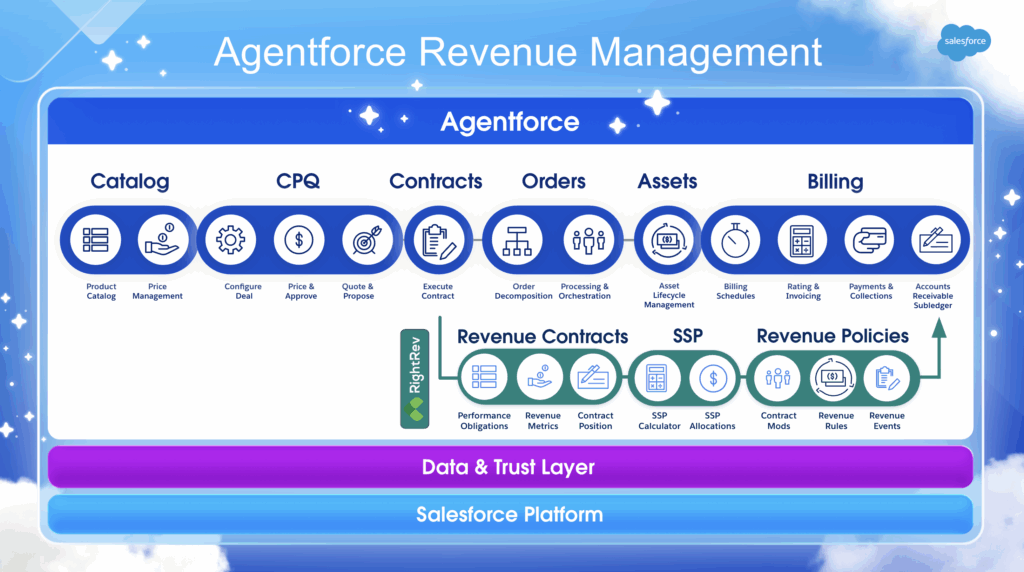
Salesforce has already transformed and streamlined how organizations manage customer quotes and orders. RightRev extends that Quote-to-Cash transformation to revenue recognition.
Together, they connect order, billing, and revenue data to bring clarity to revenue management without the manual grind, ensuring the synchronization of every order, invoice, and revenue event.
A ‘single source of truth’ provides greater visibility into data, elevates confidence in financial metrics, and accelerates month-end closes without sacrificing ASC 606 compliance, enabling finance teams to focus on strategy.
Why Financial Data Automation Breaks Down in Disconnected Systems
For a typical enterprise finance team, the data lies in siloes and fragmented workflows.
Generally, this creates a scenario where:
- Orders sit in a customer relationship management (CRM) platform, like Salesforce
- Billing is managed in a separate ERP or custom-built billing tool
- Revenue recognition stays in spreadsheets or an ERP (which generally cannot handle complex revenue models without expensive customizations)
Each handoff introduces friction.
And this patchwork approach to accounting creates major pain points:
- Manual reconciliations between platforms consume valuable time. Finance teams spend hours reconciling mismatched financial data between systems, manually adjusting for contract amendments, and managing the disconnect between invoice and revenue schedules.
- Slow month-end closes become routine, dragging out reporting cycles. The team shifts its focus from financial planning and strategy to chasing down data sources.
- Forecasting and real-time reporting remain nearly impossible when the data is generated across multiple systems. With traditional reporting methods (e.g., manually exporting and importing .csv files), leaders lack real-time visibility into revenue, especially regarding usage-based or hybrid models. A 2023 Deloitte survey of North American CFOs found that 64% reported inadequate technology as one of the greatest challenges they face while trying to derive insights from data.
For too many CFOs and Controllers, existing systems remain disconnected, and as a result, processes do too, which significantly limits operational efficiency. Revenue recognition lags behind invoicing, and the absence of a single source of truth introduces regulatory compliance risks.
The Salesforce Advantage for Order and Billing Data
Many companies already trust Salesforce to manage sales data, customer quotes, and billing. By embedding financial workflows directly within Salesforce, organizations reduce silos and strengthen visibility across the order-to-cash cycle. When order, billing, and revenue processes live inside Salesforce, you eliminate the need for constant data manipulation and transfers between platforms.
With CPQ and Billing, companies can:
- Generate accurate quotes and contracts
- Automate invoicing
- Track customer billing status
- Manage contract amendments and renewals
For revenue teams, automated systems represent a significant advancement over managing contracts in shared drives or invoices in legacy ERP systems. Salesforce ensures that up-to-date contract data is available in real time.
Plus, a 2024 report from EY highlighted that 86% of Controllers expect their roles to become more strategic by 2030. That evolution is directly tied to a growing demand for financial automation software that provides real-time insights, predictive analytics, and automated reports. This represents a significant shift away from the traditional, backward-looking reporting that remains a hallmark of manual, spreadsheet-based financial systems.
But when it comes to revenue recognition, billing data is only part of the picture. Subscription and usage-based models require correctly allocating revenue, applying variable consideration when necessary, and aligning recognition with performance obligations. That’s where spreadsheets or disconnected systems creep back in.
Fortunately, RightRev helps extend Salesforce’s reach and close the loop on true Quote-to-Revenue automation. Together, they allow you to gain visibility into bookings, billings, and revenue, all in one place.
How RightRev Extends Salesforce into Revenue Recognition
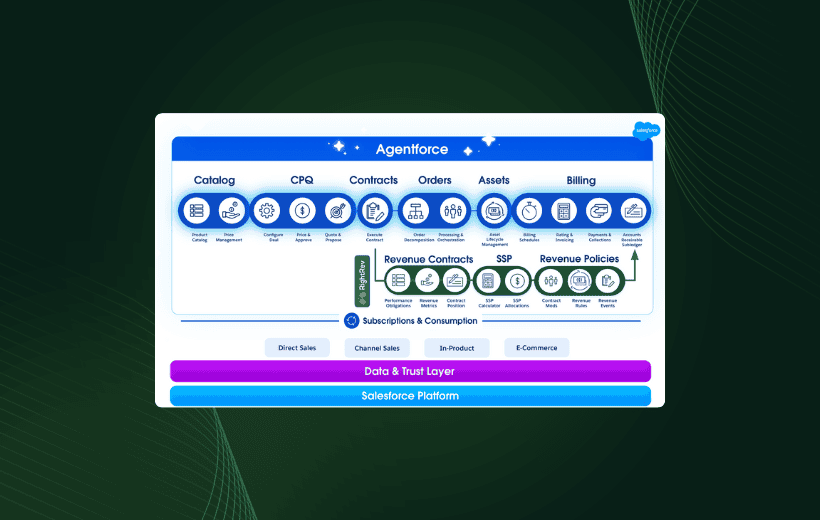
RightRev sits within Salesforce Revenue Cloud, intelligently recognizing activated orders to automatically generate Revenue Contracts. Teams can manage revenue recognition directly within Salesforce without risking ASC 606 or IFRS 15 noncompliance.
RightRev extends the value of Salesforce Revenue Cloud by:
- Streamlining Order-to-Revenue processes: RightRev automates revenue schedules for every order, including subscription, usage-based, or hybrid contracts. Teams no longer need a separate tool or spreadsheets to manage revenue recognition.
- Providing support for complex scenarios: RightRev supports complex contract arrangements, such as bundled contracts, frequent contract modifications, or consumption-based models where revenue fluctuates monthly.
- Real-time visibility: With RightRev embedded in Salesforce, teams can see real-time revenue and dashboards that compare billings, deferred revenue, and recognized revenue for every contract.
RightRev doesn’t replace your billing system; it complements it by delivering the revenue automation layer within Salesforce. As Salesforce revenue recognition software, it’s built to run seamlessly within Salesforce or standalone, as needed. With RightRev, Salesforce transforms from a contract hub into a complete order-to-revenue platform.
The Benefits of Financial Reporting Automation for Finance Leaders
As a finance leader, you know the stress of every month-end close. Disconnected spreadsheets force accounting teams to chase down contract terms, reconcile billing and invoicing, and juggle reporting from multiple, disparate systems. The process is time-consuming, and it undermines trust in the reported numbers when done manually (e.g., data entry errors, reissuing financial statements).
By employing automation tools, manual reconciliations disappear, and your team unlocks outcomes that directly impact growth:
- Faster, more accurate closes: Automated processes handle the entire Quote-to-Cash process. That means you lose less time chasing data and gain more confidence in reported numbers. According to a 2024 survey from SAPinsider, 64% of finance leaders cited improved efficiency of their financial close as the top benefit expected from leveraging automation.
- Real-time financial insights: With automated reporting systems, finance departments can leverage advanced analytics to view the entire order-to-revenue lifecycle in real-time, rather than weeks later.
- Reduced risk of error: Automated revenue reporting tools eliminate human error resulting from manual data entry.
- Strategic focus: By automating the Quote-to-Cash process, teams can shift their focus to revenue forecasting and scenario planning, and they’ll reclaim the bandwidth needed to support new initiatives.
- Improved stakeholder confidence: When CFOs and Controllers are forced to rely on out-of-date data for board, investor, and other reporting purposes, there’s a much greater chance that corrections must be issued later on; the resulting financial restatements can shake confidence, especially if performance is worse than initially reported.
RightRev helps companies foster their financial rigor and resilience by embedding automated revenue reporting and ASC 606 compliance within Salesforce (or as a standalone integration).
For a Controller, this means fewer manual reconciliations and faster closes, as automated financial processes and system-level controls help ensure every revenue event is tied back to the originating contract.
For a CFO, it means forecasting revenue and financial performance with confidence. And so that compliance isn’t a concern, built-in audit trails show exactly when, how, and why revenue was recognized, providing auditors with the means to easily connect order, billing, and revenue events.
Compliance and Trust Built into the Process
Finance leaders are under more pressure than ever to generate financial reports that provide timely, accurate insights. Boards want to see revenue forecasts that match customer demand.
Auditors want airtight compliance with ASC 606 and IFRS 15. Investors want proof that recurring revenue is sustainable.
Manual data entry in spreadsheets leaves finance exposed. Without version control, formulas are undocumented, and audit confidence evaporates.
With revenue automation tools like RightRev, here’s how compliance is embedded in the process:
- ASC 606 and IFRS 15 alignment: Recognize revenue accurately and consistently according to either domestic or international standards.
- Audit trails: Every allocation, adjustment, and transaction is tracked and logged automatically.
- Elevated access requirements: For both data integrity and compliance purposes, Salesforce’s configurable role-based access controls (RBAC) prevent unauthorized and unintended users (e.g., Sales) from accessing finance and accounting data.
- Trust at every level: Whether it’s auditors, boards, or investors, stakeholders gain confidence in the transparency of financial operations.
When finance leaders know their accounting systems and reporting processes are watertight, they can confidently pursue new pricing strategies without fear of compliance setbacks.
The Bottom Line: One Unified Revenue Recognition Engine With Salesforce + RightRev
Disconnected systems, the absence of financial data automations, and traditional financial reporting tools leave finance professionals vulnerable to mistakes, delays, and missed opportunities. They put your company’s financial health at risk.
Salesforce has already given organizations visibility into orders and billing. RightRev completes the picture by automating revenue recognition and providing real-time insight into revenue.
By combining Salesforce and RightRev, companies gain:
- A single source of truth for orders, billing, and revenue
- Automated Order-to-Revenue software that eliminates manual tasks without compromising data security or compliance
- Confidence in revenue reporting without the manual grind
If your finance team is tired of reconciling and managing financial data manually and worried about hidden errors, it’s time to look at Order-to-Revenue automation software differently. Salesforce plus RightRev gives you a complete solution across the order-to-revenue lifecycle, letting you focus on strategy, growth, and building trust.
Ready to see how RightRev transforms financial data automation inside Salesforce?
Request a demo today and discover how automated systems bring data accuracy, compliance, and real-time insight to your financial processes.