Before launching an AI product with credit-based pricing, finance and accounting need to agree on four definitions: what a credit buys, what a free credit is worth, how credits are consumed and recorded, and who signs off. Because how credits are billed, allocated and recognized depends on these prior decisions.
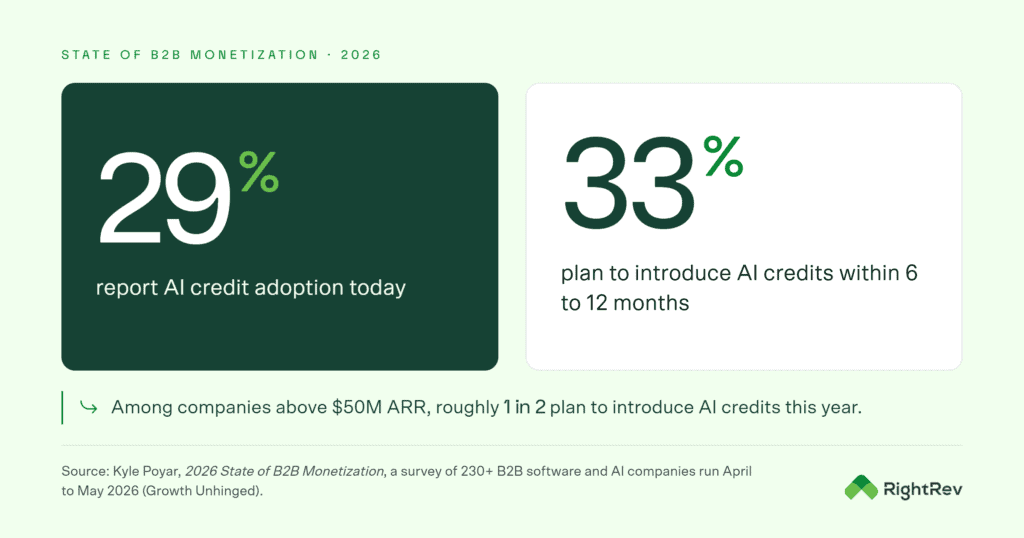
That was the common thread of a September 30 webinar hosted by Angela Liu of Gaapsavvy. RightRev CEO Jagan Reddy, and Metronome CFO Adam Klein described what happens when those questions are left until the end of the decision process. Plenty of finance teams are about to learn this firsthand. Credit-based pricing is moving quickly from experiment to default:
Why Finance Has to Be in the Room Before Launch
Adam said pricing used to be built by product, with finance taking an output from the billing system and modeling from there. Now finance, product and sales leadership work on pricing and packaging together. At Metronome, the leadership team met in person about every six weeks to plan continuously.
“Finance needs to help design it from the beginning.”- Jagan Reddy, founder and CEO, RightRev
Metronome’s report names billing complexity, including managing downstream accounting workflows, among the top three challenges of implementing usage-based pricing. Angela polled her Gaapsavvy community on a familiar scenario: sales wants to try a new selling model within a month, with no proof customers will pay for it.
It shows how often the commercial plan arrives first. In Angela’s view, the old sequence, where product figures it out and accountants sort it out downstream, no longer works. Jagan said the usual response to a late start is a workaround. Teams manipulate the data or build customizations to fit deals into the system, and sometimes change the revenue policy itself. He estimates the rework costs ten times what was originally spent. Settling a few definitions before launch can avoid much of that rework, starting with the most basic one.
What Does a Credit Actually Buy?
A credit buys whatever the contract defines it to buy: a metered unit of usage, a draw against a bucket shared across services, or a delivered outcome. That makes it the first definition finance has to settle, because it decides what gets metered, how credits are drawn down, and what revenue accounting needs from the metering data.
Start with the unit. Jagan described engineering teams that “blindly meter everything” and apply one flat rate to the units, without reading the contract to see whether it includes free credits or tiered pricing.
Credit buckets add a second question. Jagan gave an example: a customer buys $10,000 of credits, then uses three services in month one and five in month two. Revenue cannot be allocated once across the whole contract, so some customers treat each month as a subcontract under the main one and allocate standalone selling price across the services consumed that month.
Angela added that the menu of credit definitions keeps growing as vendors sell multiple named agents instead of one. That makes sub-allocation heavy math, and it can drift from billing reality.
Credits can also map to outcomes. Jagan said the pattern he sees is more credits applied for better outcomes, with no change in price. That puts the weight on how the outcome is defined.
The definition has to be settled up front: what success means, and who approves that the outcome was delivered. Size matters too, because the number of credits applied can vary widely with the outcome. Deloitte has published a Technology Spotlight on accounting for outcome-based pricing in agentic AI products, which Angela referenced during the session.
Adam gave the test case. An AI closes a support ticket, but the question was never resolved and the issue moves to a human. Do we count that as a consumed credit?
What is a Free Credit Worth?
Free credits are the clearest example of a decision that crosses teams. They appear in the contract and in the metering data, and revenue accounting needs both.
They are also becoming routine. Angela noted that free credits now show up in consumer AI subscriptions too, after she received a notice of free credits following a provider’s pricing plan change.
The common assumption is that customers use free credits first, so revenue starts once paid credits begin to be consumed. In Jagan’s experience, auditors have taken a different view. They required value to be assigned to the free credits, with allocations that recognize revenue from the start and amortize the free credits across the term alongside the paid ones.
Adam said his own team is working through the same question with its accountants and auditors. Straight-lining free credits on a usage-based product can produce negative revenue in the early months, which is hard to explain to a board and hard to automate.
Treatment depends on the contract and on what auditors will accept, and neither panelist offered a universal answer. That is the case for deciding it before launch.
How Credits Are Consumed and Recorded
Angela described the audit scenario that follows when consumption records are thin: teams screenshotting evidence and unable to say whether free credits were consumed first in, first out.
She added that if the first event is never created, it can never be billed or recognized, and creating an event is an engineering decision.
Jagan gave a second case. A customer asks to be billed quarterly instead of monthly. Engineering can handle that on the billing side, but finance still needs the underlying metering data to recognize revenue, and nobody planned for it.
Both cases trace back to the same gap: no one agreed on what counts as consumption before launch. What triggers a consumption event, which credits burn first, and what metering data finance needs to recognize revenue have to be agreed upon and documented upfront. Auditable accounting flows from those decisions.
Every Definition Needs a Sign-Off
The panelists’ accounts point to one rule: every definition gets a named owner and a finance sign-off before the first contract ships.
| Define this | Why finance needs it | Example |
|---|---|---|
| What a credit buys | Sets what gets metered and how revenue is allocated across services and outcomes | A $10,000 credit bucket spread across three services, then five services the next month |
| What a free credit is worth | Sets when revenue starts and how the credit is amortized | Auditors asking for value on zero-dollar credits; negative revenue risk |
| How credits are consumed and recorded | Decides whether consumption can be evidenced at audit | First in, first out and screenshots as evidence |
| Who signs off | Decides whether finance sees the definition before launch | Finance, product and sales working on pricing together |
Before launching credit-based pricing, finance can ask four questions:
- Do the credit terms in the contract match the credit rules in the metering configuration?
- Is there a documented position on free credits, agreed with accounting?
- Can consumption be traced credit by credit, including which credits were used first?
- Does each definition have a named owner and a finance sign-off?
From Definitions to a Ledger You Can Audit
Credits are not one pricing model. They are many. Prepaid commits, drawdown wallets, free and promotional credits, rollover rules, overages, and subscriptions with included usage can all sit in the same customer base, often in the same contract. Each one changes what gets billed, when revenue is recognized, and what an auditor will ask to see.
Spreadsheets cannot keep up with that. Neither can billing systems built for flat subscriptions, or a close that depends on manual true-ups at quarter end. AI companies now ship new pricing in weeks, sometimes days. Finance needs systems built for usage and consumption from the start, so pricing can change without breaking the books.
That is where purpose-built tools come in. Metronome handles metering, credit drawdown, and usage-based billing, so every consumption event is captured and priced the way the contract says. RightRev turns those events into recognized revenue under ASC 606. It allocates across credit buckets and traces every journal entry back to the usage that drove it. Together they give finance one auditable path from contract to consumption to the ledger.
The definitions still come first. Agree on them, document them, and give each one an owner. Then put them in systems that apply them the same way every time. That is how finance stops being the bottleneck and moves at product speed.
For more on how pricing models reach the ledger, see RightRev’s Revenue Recognition in the AI Era: Critical Lessons for Modern Businesses AI Revenue Recognition.
To see how RightRev allocates revenue across credit buckets on your own contracts, request a demo.